
Argentina’s LPG Moment: From Regional Supplier to Global Force
For years, the global LPG market has celebrated its growth story. Supply has expanded, trade flows have deepened, and new demand centers have emerged across Asia, Latin America, and beyond.
And yet, recent events have reminded us of a fundamental truth: global LPG remains structurally concentrated.
Despite the rise in liquids production worldwide, the market still leans heavily on two pillars—the United States and the Middle East. Together, they anchor global supply, pricing, and trade flows. But concentration comes with risk.
When disruptions occur—whether from geopolitical tensions in the Middle East or logistical challenges elsewhere, the impacts are felt immediately across the globe. The recent instability affecting shipments through the Strait of Hormuz is a clear example. Buyers scrambled, trade routes shifted, and the world began searching—urgently—for alternative supply.
And in that moment, a new contender stepped forward.
Argentina Steps onto the Global Stage
Argentina has long been part of the LPG conversation—but largely as a regional supplier. That narrative is now changing.
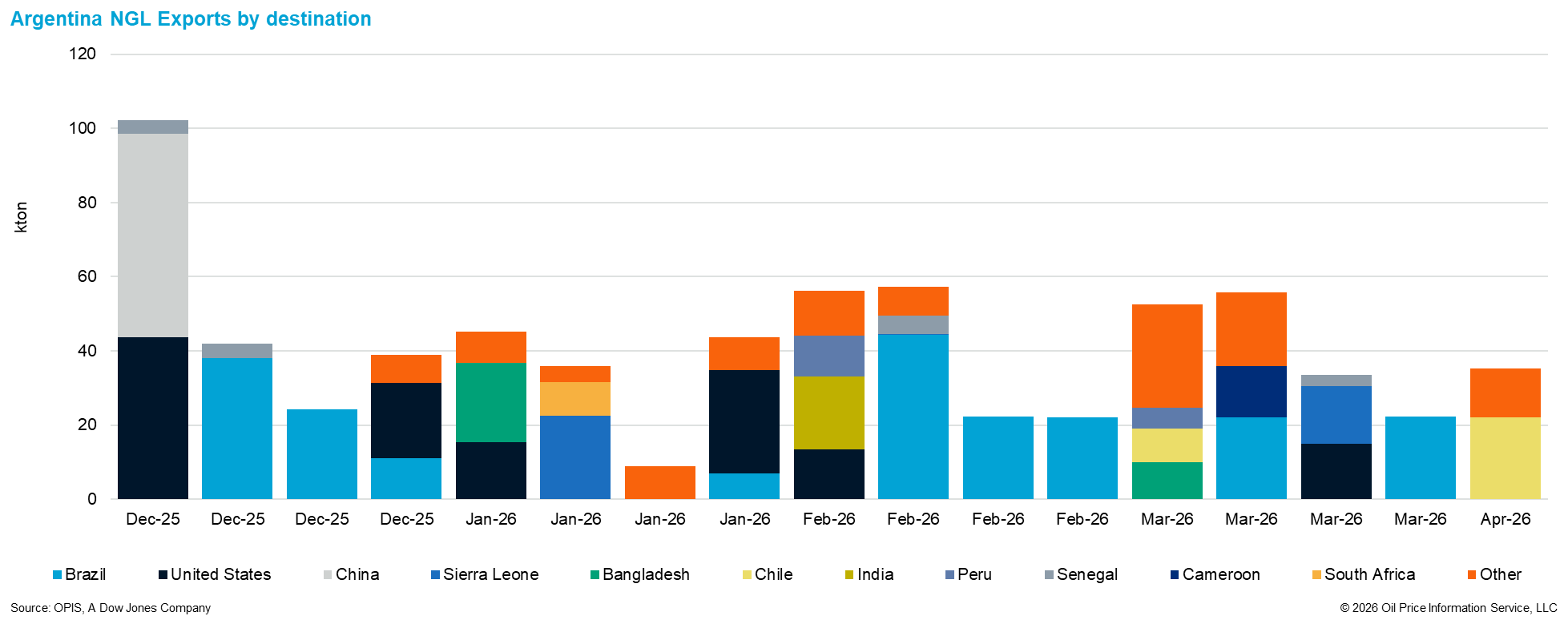
In a landmark development, Argentina recently shipped LPG cargoes to India, stepping beyond its traditional Atlantic Basin footprint to participate directly in one of the world’s most competitive demand centers.
This is more than a one-off trade flow.
It is a signal.
A signal that Argentina is no longer theoretical in its global ambitions—it is operational.
A signal that the global LPG map is evolving.
And perhaps most importantly, a signal that supply diversification is no longer optional—it is happening.
Vaca Muerta: The Engine Behind the Shift
At the heart of Argentina’s emergence is the development of Vaca Muerta—one of the world’s most prolific unconventional resource plays.
With vast reserves and improving productivity, Vaca Muerta is unlocking a new wave of liquids production, including:
- Propane
- Butane
- Ethane
- Natural gasoline
But resource alone is not enough.
What makes this moment different is the parallel commitment to infrastructure—fractionation capacity, export terminals, and logistics networks designed to move molecules from the wellhead to the global market.
Argentina is not just producing more.
It is building the system required to compete globally.
Why This Matters for the Global Market
For a market consumed in over 200 countries and territories, supply diversity is not a luxury—it is a necessity.
The entrance of Argentina as a credible global supplier introduces three critical shifts:
1. Geopolitical Diversification
A third meaningful supply axis reduces dependence on traditional exporters and enhances resilience during disruptions.
2. Trade Flow Reconfiguration
Atlantic Basin barrels can now reach Asia more competitively, reshaping arbitrage economics and freight dynamics.
3. Structural Optionality
Buyers gain leverage—more origins, more flexibility, and more strategies to manage risk.
In short, Argentina’s rise is not just incremental supply—it is strategic optionality for the global LPG system.
An Arrival at the Right Time
Timing matters in commodity markets.
Argentina’s global debut comes at a moment when the world is actively seeking alternatives—when reliability, diversification, and flexibility have become top priorities.
The shipment to India is both proof of concept and proof of capability.
It demonstrates that Argentina can:
- Compete on distance
- Execute on logistics
- Deliver into premium demand centers
And it accelerates what was once a long-term expectation into a near-term reality.
The Bigger Picture: A More Distributed Future
The global LPG market is entering a new phase.
The dominance of traditional supply centers will not disappear—but it will be complemented by emerging players capable of stepping in when it matters most.
Argentina is now firmly in that category.
And as Vaca Muerta continues to scale, its role is set to grow—from opportunistic exporter to structural participant in global trade.
Final Thought: Watching the Signals
In today’s LPG market, the question is no longer whether new suppliers will emerge.
It is how quickly they can scale—and how effectively they can integrate into global flows.
Argentina has just answered part of that question.