Middle Eastern Styrene Exports Come To Near Full Stop
Saudi Arabia and Kuwait typically account for approximately 34% of global styrene monomer (SM) trade flows.
SM exports, which were primarily shipped via the Gulf and the Strait of Hormuz, have come to an almost complete stop, resulting in force majeure declarations on SM supply from CP Chem and SABIC in Saudi Arabia and Equate in Kuwait.
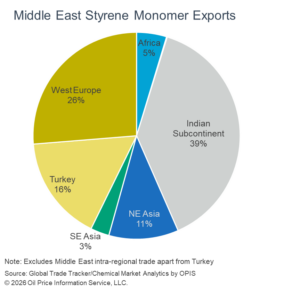
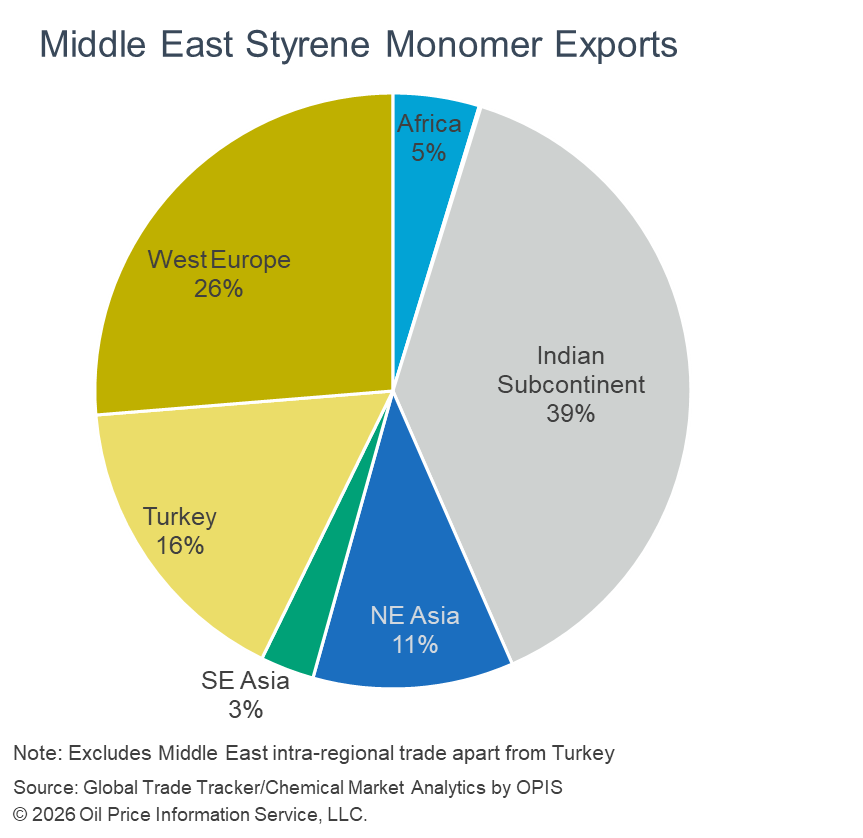
The bulk of the region’s exports go to India (850 kt per year), Europe (430 kt per year), and Turkey (290 kt per year).
In theory, Asia and the US have sufficient styrene capacity to fill the gap, but the supply chain from Asia will be extended by a month if flows must be diverted around Africa. Asian producers’ potential to fill the gap is also affected by the current lack of feedstocks in the region due to the crisis. The Asian market has also tightened considerably, so there has been a focus on intraregional trade.
India has had to rely on increasing its import volumes from Northeast Asia, as over 70% of India’s styrene imports in 2025 came from Kuwait and Saudi Arabia. However, Indian buyers will very likely be required to pay a premium to secure these cargoes, and due to feedstock limitations in the region, substantially increasing operating rates will likely be challenging.
For Europe, the US would be an obvious alternative supplier, but it is impossible to backfill entirely from the US, and the removal of Middle Eastern supply has caused significant and immediate changes to the European market.
Although North American styrene producers were not running at full rates prior to the conflict, closures in recent years and planned outages have severely limited spare volume available in the region to cover the global shortfall of substantially restricted exports from the Middle East. The US market may have some additional volume available for exports in the coming months as turnarounds end though, and rapid price increases could create some incentive for other plants to raise rates.
Flows from Asia to the EU/Turkey have been forced to take a longer route, so they have been affected by longer delivery times and higher shipping costs. Turnarounds in the EU and limited supply from the Middle East, the US, and Asia will further tighten the regional SM market. SM prices have spiked in all three regions due to the rapid supply loss and higher cost structures.
—Reporting by Megan Brenchley, Associate Director, EMEA Styrenics