
The Permian Drilling Paradox of Negative Gas Prices and Resilient Oil Economics
It is rare for crude oil prices to fall into negative territory. The last time the market saw that kind of shock was during the early stages of the pandemic. But negative natural gas prices at West Texas’ Waha hub are far less extraordinary. In fact, Waha has spent more time below zero than above it so far this year. Since the Iran-U.S./Israel war, the pressure has intensified, with prices collapsing to an unprecedented range of -$6 to -$8/MMBtu in mid-April.
A negative gas price is straightforward in meaning: the direction of payment has reversed. The market is so oversupplied in this trading hub and takeaway capacity so constrained that producers must effectively pay midstream operators or other counterparties to take the gas away. The molecule still has value elsewhere. At Waha, however, it has become trapped.
The underlying problem is not new. Permian producers drill primarily for oil, and the gas comes out with it, whether they want it or not. The shale boom has driven Permian tight oil production to nearly five times the level of a decade ago, and associated gas volumes have surged alongside it. Pipeline expansions have been constant, but infrastructure expansion has repeatedly struggled to keep pace with production growth, especially as new production has become increasingly gassier. Once available takeaway capacity fills, even relatively small disruptions from pipeline maintenance, compressor problems or unexpectedly strong production can cause Waha prices to collapse.
High crude prices only make the imbalance worse. A strong oil-price environment encourages producers to add rigs, complete more wells and maximize liquids production. Recent increases in oil-directed drilling activity—with the oil rig count rising by about 10% from its pre-war level—suggest that this response is already underway. But every additional oil well also introduces more associated gas into a basin that is already wrestling with excess volumes. From a gas-only perspective, some of this production may look uneconomic. But from a field level perspective, they often still make sense, as oil revenue overwhelmingly carries the well economics, and NGL realizations can further cushion the blow. In other words, producers may lose money on the gas stream while still making attractive returns on the barrel. Even with steep losses on the gas stream, combined oil and gas revenue in early April remained more than 50% above the pre-conflict level, largely supported by crude prices above $100 per barrel.
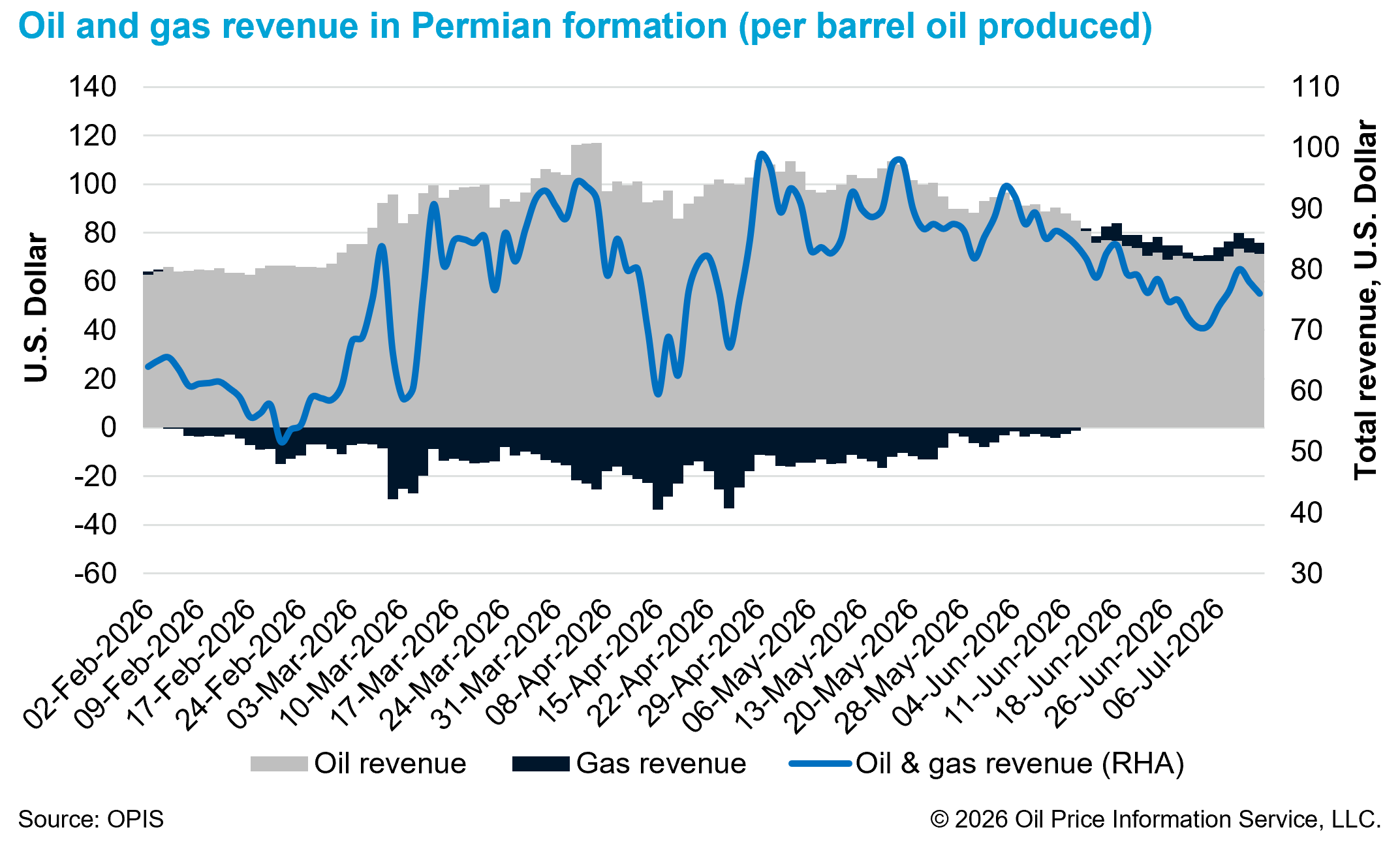
Moreover, operational realities reinforce that behavior: shutting in gas can force oil shut-ins, hurt reservoir performance, or run against lease and contractual obligations. So even when gas prices turn sharply negative, producers do not always have the flexibility to respond by simply turning the taps off.
Near-term relief arrived in late June, when Kinder Morgan placed the 0.57 Bcf/d Gulf Coast Express expansion into service. Waha prices subsequently returned to positive territory and remained above zero as of this writing. The next major addition will be the 2.5 Bcf/d Blackcomb Pipeline, which is expected to begin transporting Permian gas to the Agua Dulce area in South Texas in the third quarter of 2026. Energy Transfer’s Hugh Brinson Pipeline is scheduled to follow, with an initial 1.5 Bcf/d phase targeted for service in the fourth quarter of 2026 and a second phase expanding total capacity to 2.2 Bcf/d in the first quarter of 2027.
However, the market should not assume that the new infrastructure coming online this year will permanently resolve the imbalance. Previous pipeline additions have often filled quickly as producers responded to improved market access. If crude prices remain supportive, continued oil-led production growth could absorb much of the new takeaway capacity sooner than expected. Conversely, a more measured pace of crude production growth would allow the additional capacity to provide more durable relief.
–By Tracy Cui