
EU ETS Review: Why the Timing of Scarcity Matters
The proposed reform could make the carbon market more flexible, but also more complex. For companies planning compliance, investment and hedging, the details of how the rules evolve will matter for long-term prices, competitiveness and predictability.
The EU Emissions Trading System (EU ETS) is entering a new phase of debate. The European Commission’s review proposal would adjust how allowance supply changes over time, expand or refine several market mechanisms, and connect parts of industrial support more closely to decarbonization investment. Parliament’s preliminary proposals point in some areas to a different route.
The legislation is still being negotiated. That means companies should treat the proposals as possible future rules, not settled policy. But the debate already raises a practical question: if the system continues to tighten, how quickly — and through which mechanisms — will allowance availability change?
A Tighter Market, With More Moving Parts
The EU ETS remains designed to reduce emissions over time. The review does not remove that direction. Instead, it could alter the pace and shape of the transition by changing the cap trajectory and introducing or adjusting mechanisms that affect how allowances enter, leave or move through the market.
That distinction matters. Two policy pathways can point toward lower emissions while producing different market conditions along the way. For businesses with long-lived assets, multi-year investment plans or ongoing compliance obligations, the timing of those changes can affect procurement, budgeting and project decisions.
The Market Stability Reserve May Take on a Broader Role
The Market Stability Reserve (MSR) has traditionally helped manage excess allowances. Under the proposed changes, its role could become more two-sided: as the market balance tightens, the reserve may also help manage liquidity by releasing allowances under specified conditions.
For market participants, the key issue is not simply whether the MSR can intervene. It is how its rules interact with the allowance balance, the pace of emissions reductions and other supply measures. Those interactions could influence when the market feels tighter — and how policy changes are transmitted to participants.
Industrial Policy Is Becoming Part of Carbon-Market Planning
The review also links support for industry more closely to investment in decarbonization. Proposed changes to free allocation could make a company’s plans and progress relevant to the allowances it receives. Meanwhile, new funding mechanisms are intended to support industrial projects and the deployment of lower-carbon technologies. However, conditionality may add uncertainty.
This brings carbon-market strategy closer to operational and capital-planning decisions. Companies may need to consider not only their emissions outlook and allowance needs, but also the timing of projects, eligibility requirements and how policy conditions could affect future allocation.
New Sectors and Technologies Add Complexity
The proposals extend or adjust the system’s reach across parts of aviation, maritime transport and waste. They also address international carbon credits and domestic carbon removals. These measures could broaden the sources of demand and supply, while bringing different emissions profiles, costs and implementation timelines into the market.
The impact will depend on final design and delivery. In particular, the credibility and availability of eligible credits, the pace at which removal technologies scale, and the details of sector coverage will all shape how these provisions work in practice.
What Market Participants Can Do Now
With negotiations ongoing, companies do not need to make decisions based on a single assumed outcome. A more resilient approach is to track the policy questions that could materially change exposure:
- How will the post-2030 cap trajectory be set, and what conditions will apply?
- How might the MSR respond as the allowance balance changes?
- Could free-allocation rules affect the timing or cost of compliance?
- When will new sources of allowance demand or supply become operational?
- What assumptions should be tested across long-term procurement and investment plans?
- Will the review make the system more predictable and stable?
The answers will emerge through the legislative process. Until then, scenario-based planning can help companies understand where their exposure is most sensitive to policy choices — and which decisions may be robust across more than one outcome.
The EU ETS review is about more than a change to the cap. It could reshape how allowance supply is managed, how industrial support is delivered and how companies connect decarbonization investment with compliance planning. The long-term direction remains emissions reduction; the uncertainty lies in the route and timing of scarcity. That uncertainty matters for prices. Our modelling of three scenarios points to the post-2040 EUA range of roughly Euro 158/mt to Euro 204/mt after review.
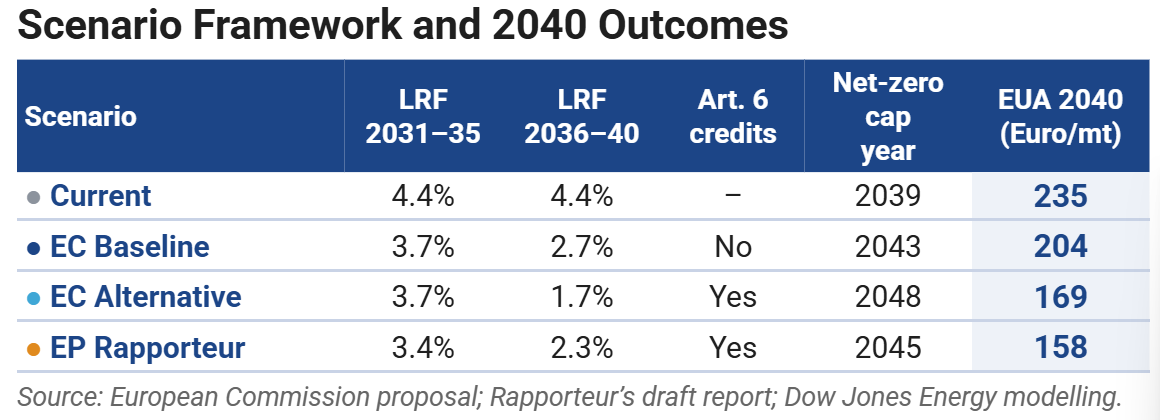
For market participants, following the legislation closely is important. Understanding how the different proposals interact, and what those interactions could mean for future market balances and prices, will be essential as the review progresses.
This article discusses proposals under review and is for general information only. It does not constitute investment advice. The CAMIRO team analyzes these scenarios in detail. Subscribe to CAMIRO here.