European Solar Market Gains Resilience as Buyers Shift Strategy
Europe’s solar market is showing signs of renewed resilience as stable module pricing, stronger downstream demand and shifting procurement priorities begin to reshape buying behavior across the region. While module prices have remained largely unchanged in May, conversations across the supply chain suggest the market is becoming increasingly driven by strategic purchasing, energy security concerns and policy-led sourcing decisions.
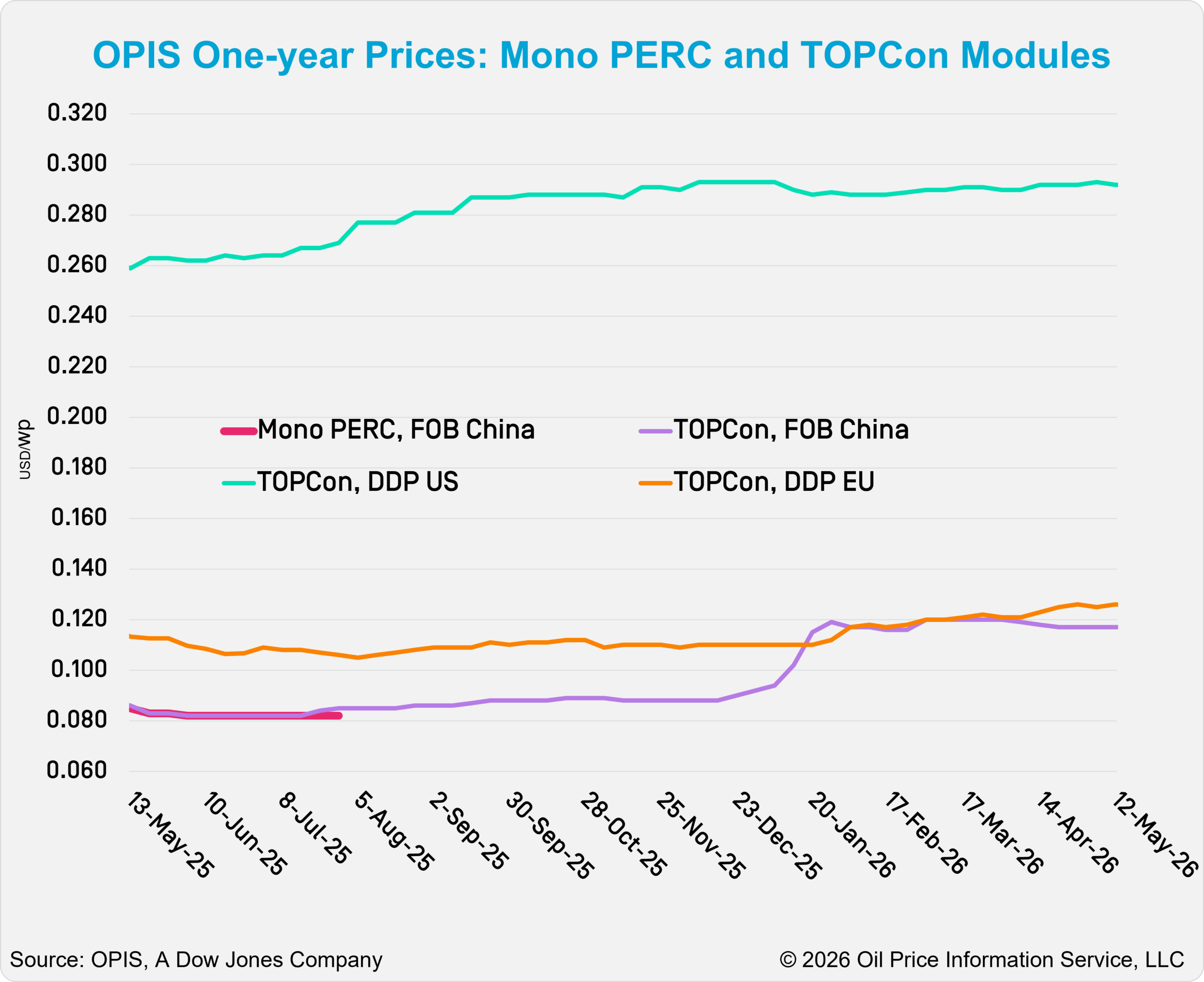 Prices for imported TOPCon panels delivered into Europe continued to hold firm in the first two weeks of May. OPIS assessed Delivered Duty Paid (DDP) prices for modules above 600 wp at €0.107/wp ($0.126/wp), while smaller-format modules in European warehouses (EXW) remained stable around €0.110/wp.
Across Europe, project developers and distributors are increasingly splitting procurement between immediate spot purchases and forward volume commitments, seeking to reduce exposure to freight volatility, raw material fluctuations and geopolitical disruptions. Several market participants said contract negotiations have become more sophisticated, with fixed-price agreements and index-linked formulas gaining traction.
This shift comes as solar buyers attempt to avoid the procurement disruptions experienced earlier this year when sharp movements in the price of silver used in photovoltaic panels, together with volatile logistics costs forced project fundamentals to be reassessed.
Demand Momentum Builds
While large-scale infrastructure projects continue to face familiar challenges, including permitting delays, grid congestion and tighter financing conditions, activity in distributed generation is slowly accelerating.
Manufacturers supplying Europe reported stronger-than-expected order activity from commercial installers, rooftop developers and residential channels, particularly in Northern Europe and the U.K.
According to market participants, concerns over energy affordability and broader geopolitical instability are encouraging faster purchasing decisions among smaller buyers, many of whom are prioritizing supply security over short-term price optimization.
Suppliers Stay Defensive
Despite weak pricing signals upstream, suppliers remain reluctant to lower offers into Europe.
Chinese TOPCon export prices Free-on-Board (FOB) remained stable at $0.117/wp (€0.100/wp) in weeks 21 and 22 (May 18 and 25), while polysilicon benchmarks remained unchanged, suggesting limited immediate cost pressure from upstream markets. At the same time, cell pricing softened modestly, indicating there is sufficient supply across Asia.
Under normal market conditions, such fundamentals might encourage more aggressive pricing into Europe. However, many suppliers are maintaining current pricing levels as container shipping costs remain volatile on Asia-Europe routes and geopolitical tensions in the Middle East continue to create uncertainty around global logistics amid the closure of the Strait of Hormuz.
EU Regulation
Policy developments are also beginning to influence commercial decisions more directly.
Across Europe, project developers report growing customer interest in supply-chain transparency, ESG compliance and sourcing strategies aligned with Europe’s Net-Zero Industry Act (NZIA).
In markets such as France and Germany, upcoming procurement reforms are expected to place greater emphasis on resilience, cybersecurity and diversified sourcing, potentially reducing the dominance of purely price-based tendering.
This evolution is creating clearer segmentation between commodity-driven procurement and projects willing to pay premiums for compliance, origin transparency or lower embedded carbon.
Meanwhile, interest in European-made modules continues to grow in specialist segments including agrivoltaics, building-integrated solar and premium residential applications, although industry participants acknowledge that gigawatt-scale local manufacturing remains a medium-term ambition rather than an immediate market force.
Beyond pricing, market sentiment suggests solar is becoming increasingly embedded in Europe’s broader economic and energy strategy.
Continued volatility in gas and oil markets, combined with persistently elevated retail electricity costs, is reinforcing the attractiveness of photovoltaic (PV) systems for both households and commercial consumers.
Rather than being viewed solely as a low-cost generation technology, solar is increasingly positioned as a strategic hedge against imported energy volatility and long-term geopolitical risk.
For now, European solar module prices appear well supported and stable at these levels.
Lower upstream costs continue to provide theoretical downside pressure, but freight uncertainty, geopolitical risk, regulatory evolution and stronger downstream demand are collectively supporting current pricing levels.
As Europe moves further into the second quarter, the market is expected to remain stable, but increasingly complex, with purchasing decisions shaped less by those who offer the lowest price, and more by certainty, compliance and long-term supply confidence.