European Solar Market: PV Shifts Beyond Price
European prices for imported solar modules remain broadly stable despite persistent oversupply and weaker factory pricing in China. But conversations across the industry suggest the market is entering a new phase, where procurement decisions are increasingly driven by logistics, policy, technology and long-term project economics rather than price alone.
Following two years of unprecedented price declines, the European photovoltaic market is showing signs of a more balanced competitive landscape. As prices stabilize, suppliers are increasingly differentiating themselves through supply chain resilience and compliance with evolving regulatory requirements, reflecting a market that is maturing beyond pure price competition.
Freight Costs Offset Weaker Factory Prices
Recent price movements highlight the growing disconnect between manufacturing costs in China and delivered prices in Europe.
FOB China TOPCon module prices continued to soften this week, with OPIS assessing the benchmark at $0.112/wp. Forward prices also shifted into slight backwardation, reflecting expectations of demand at the prompt but slowing further out, amid declining production costs and a gradual transition towards higher-efficiency products such as advanced TOPCon and back-contact (BC) modules.
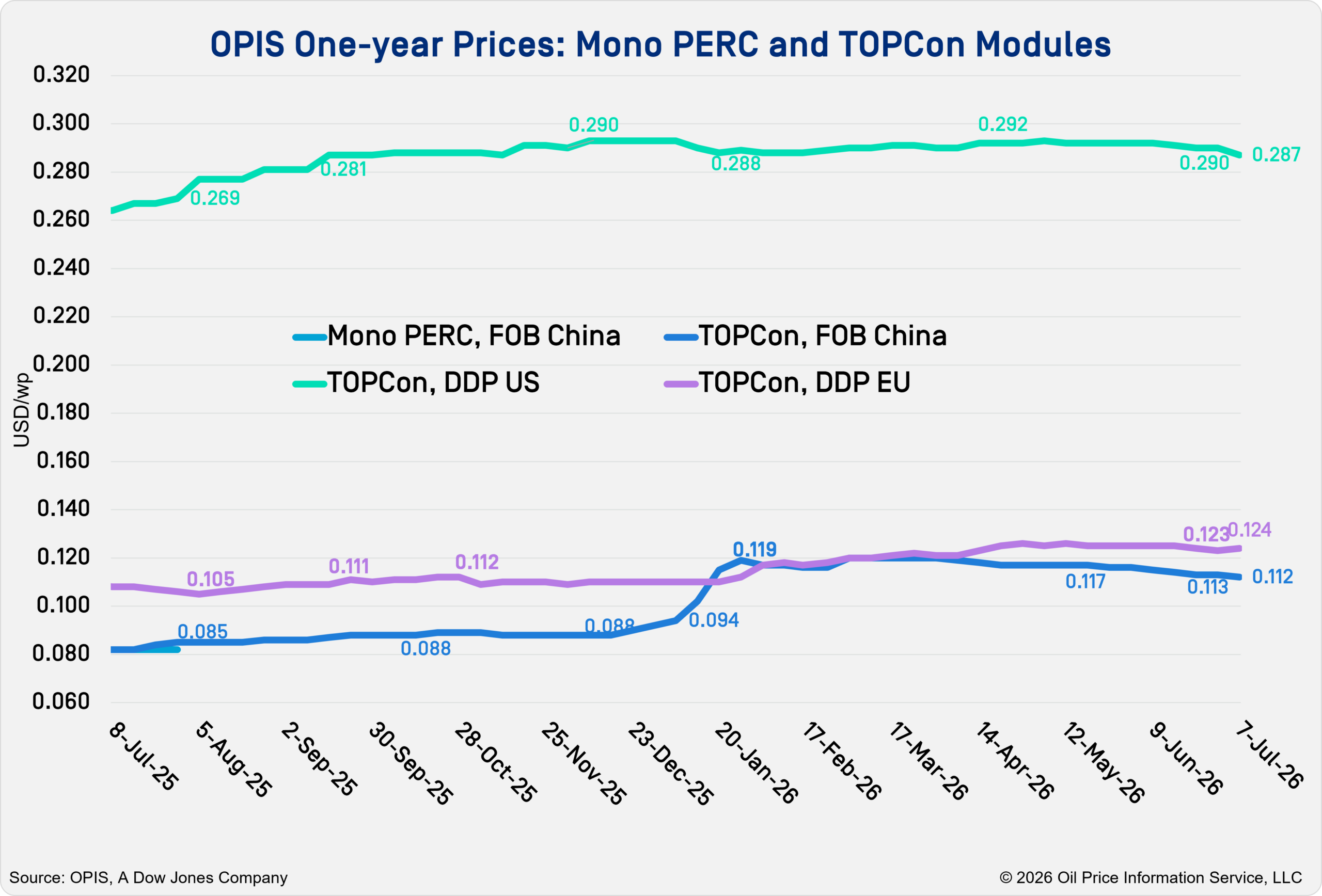 According to OPIS assessments, Delivered Duty Paid (DDP) prices for imported TOPCon modules above 600wp averaged €0.109 ($0.124)/wp on July 7, a modest 0.9% increase from the previous week. Meanwhile, smaller-format TOPCon modules already available in European warehouses remained unchanged at around €0.111/wp ex-Works (EXW) Europe. The slight increase in utility-scale pricing reflects higher transportation costs rather than any significant change in manufacturing costs.
Container freight rates between East Asia and Northern Europe have increased sharply over recent weeks, while routes to the Mediterranean have risen even more as shipping companies continue to manage vessel capacity, implement peak-season surcharges and reroute ships around the Cape of Good Hope. Although freight represents only a small proportion of overall module costs, it has been sufficient to support delivered prices into Europe.
According to industry sources, freight costs are likely to remain elevated for some time as geopolitical uncertainty continues to disrupt global shipping patterns. The resulting uncertainty has encouraged many buyers to adopt a wait-and-see approach, carefully balancing the prospect of lower factory prices against the risk of higher logistics costs.
Factory Price Declines Slow
Following two years of intense price competition, sources say some PV manufacturers have become less willing to accept orders at prices they consider uneconomic, with individual companies placing greater emphasis on margins than shipment volumes. This represents an important shift for the global solar industry. While Chinese factory prices continue to edge lower, the pace of decline has slowed considerably as manufacturers attempt to restore some financial sustainability after an extended period of heavy losses.
For European buyers, this means destination-market prices may prove more resilient than factory-gate prices alone would suggest, particularly if logistics costs remain elevated throughout the second half of the year.
Storage and Flexibility Move to the Center
The theme of battery energy storage dominated discussions during Intersolar Europe 2026.
Across Europe, developers are increasingly facing grid congestion, more frequent periods of negative electricity prices and declining returns from standalone photovoltaic projects. Battery storage is therefore becoming less of an optional addition and more of a central component of project economics.
Rather than simply maximizing electricity generation, developers are increasingly seeking to maximize the value of every megawatt-hour (MWh) produced by shifting electricity to higher-value periods and providing balancing services to increasingly constrained electricity grids. This represents one of the most significant structural shifts currently taking place in the European solar market.
Supporting this transition, the European Commission, member states and industry recently agreed to accelerate deployment of at least 35 gigawatts (GW) of energy storage over the next two years while strengthening Europe’s domestic battery manufacturing capacity.
Policy Increasingly Shapes Procurement
Industrial policy is also becoming an increasingly important commercial driver.
Across Europe, initiatives such as the Net Zero Industry Act, the European Solar Charter and new national procurement frameworks are placing greater emphasis on manufacturing resilience, transparency and supply diversification.
Italy’s recently updated and approved FER X framework, for example, provides greater investment certainty through long-term Contracts for Difference while reinforcing the country’s position as one of Europe’s fastest-growing solar markets.
Meanwhile, China has introduced mandatory quality and energy-efficiency standards covering polysilicon, wafers, cells, modules and inverters. The measures aim to phase out outdated manufacturing capacity, encourage technological innovation and address the industry’s prolonged oversupply.
Whether these new standards will materially rebalance global supply remains an open question.
A More Mature Market
Despite abundant module availability, Europe’s solar market is gradually becoming more sophisticated.
Developers are no longer making procurement decisions solely based on module price. Battery storage, logistics, supply-chain resilience, regulatory developments and technology selection are becoming equally important considerations.
Module prices remain historically attractive, but increasingly they represent only one element of investment decisions.
As Europe’s energy transition progresses, competitive advantage will depend less on purchasing the cheapest module and more on securing reliable supply, selecting the right technologies and navigating an increasingly complex policy and logistics environment.
The prolonged period of intense price competition that defined the global solar industry over the past two years may not be entirely over, but it is increasingly giving way to a market where profitability, resilience and strategic procurement matter just as much as price.