
RGGI Carbon Prices Surge as Virginia’s Return Sparks Supply Jitters
Regional Greenhouse Gas Initiative (RGGI) carbon prices have rocketed to fresh record highs, as traders scramble to reassess compressed supply in the wake of Virginia’s decision to rejoin the program.
During the week of April 27-May 4, V26 RGGI allowances for December 2026 delivery traded on ICE repeatedly above $40/short ton, with transactions reaching $58.50/st by midday Monday, May 4. On May 4, OPIS assessed RGGI V25/V26 December 2026 at $52.875/st.
Over an eleven‑session rally that began April 14, the price climbed $10.59/st or 36.82%, underscoring how dramatically sentiment has shifted in a short period at the end of April.
By May 4, the OPIS RGGI V25/V26 December 2026 price had gained a total $24.115/st, or 83.85%, from an assessment of $28.876/st on Apr. 13.
Volume Swells as Forward Prices Climb
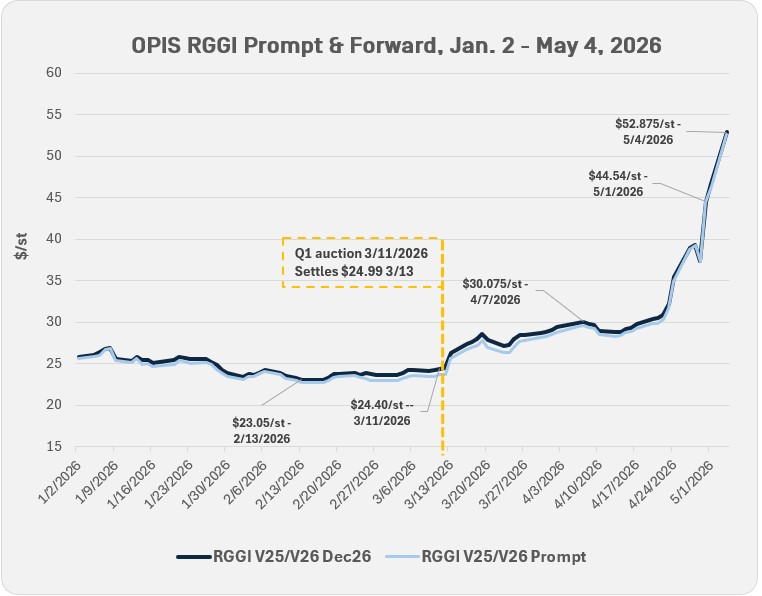 The price spike has been accompanied by a clear pick‑up in trading activity. Forward deals for V26 RGGI allowances surged on ICE between April 23 and 27, with increased volumes changing hands as the price strengthened.
OPIS RGGI forward prices rose $1.35/st on Thursday, April 23, then added $3.175/st on Apr. 24 and another $3.525/st on Monday, Apr. 27, in notably volatile sessions. One broker said during the volatile week that the market may already be short of allowances for 2026, given lingering uncertainty around Virginia’s exact reentry timing and the structure of its newly approved budget.
Virginia’s Truncated 2026 Budget Raises Eyebrows
At the heart of the rally is Virginia’s path back into RGGI.
On April 24, Virginia Gov. Abigail Spanberger approved a budget amendment that sets the state’s 2026 RGGI allowance budget at 11.48 million tons. That figure covers the period from July 1 to December 31, 2026 – essentially half of the full‑year budget of 22.96 million tons that would have applied if Virginia had participated for all of 2026.
The shorter window and compressed volume have sharpened concerns that the RGGI market will have less supply available than anticipated for the second half of the decade.
OPIS carbon policy analyst Lee Ann Bryan emphasized that this was not just a knee‑jerk move.
“We expected to see price fluctuation when Virginia passed legislation to rejoin RGGI, but this level of activity is far beyond that announcement,” Bryan said. “We could see similar price increases when Virginia begins to participate in RGGI auctions come September or if another large development takes place.”
She also pointed to the broader policy and compliance backdrop as an additional driver of price momentum.
Compliance Deadlines Add Fuel to the Fire
RGGI is currently in its sixth control period, running from 2024 to 2026. For this period, regulated generators face an annual interim control deadline before the final reconciliation.
By March 3, 2026, each covered CO₂ budget source was required to retire allowances equal to 50% of its 2025 emissions for interim compliance. Bryan noted that recent price strength may be partly linked to this March 2026 interim deadline, as compliance entities want to ensure they have enough allowances on hand for the full control period.
“This deadline, coupled with Virginia’s entry and the new Model Rule taking effect, has likely led to a heightened sense of need for allowances,” she said.
In other words, the market is digesting multiple sources of stress at once: a major state rejoining the program on a truncated budget, updated program rules and hard compliance checkpoints all stacked into the same timeframe.
Cost Containment Reserve Under Strain
The current rally is also playing out against a backdrop of a tighter Cost Containment Reserve (CCR) — RGGI’s main soft price‑cap mechanism.
In the first quarterly auction of 2026, held in March, RGGI sold 18.2 million allowances at a clearing price of $24.99/st. That sale once again fully depleted the annual CCR volume of 7.85 million allowances — the third straight year the CCR has been exhausted in the first auction.
Bryan highlighted that the updated RGGI Model Rule, finalized in July, added a second CCR tier, signaling that regulators recognize the need for more robust cost containment tools going forward.
“The cost containment reserve is the main mechanism, which acts as a soft price cap with extra allowances being released if the clearing prices exceed set levels. However, the CCR continues to be depleted in the first auction of the year,” she said.
With the CCR tapped out early yet again, the market is left more exposed to upside price risk for the remainder of the year — particularly as policy headlines and compliance deadlines converge.
RGGI plans to offer 18.3 million allowances in its second quarterly auction of 2026, scheduled for June 3, ahead of Virginia’s expected participation in later auctions.
According to the Virginia Department of Environmental Quality (DEQ), the state is still assessing if and when it will implement its own CCR as it re-enters RGGI in the second half of this year.
“The CCR budget for Virginia will be half of 2.296 million tons, which is 1.148 million tons,” according to the DEQ website. “The timing of the use of the Virginia CCR is to be determined.”
How Virginia Will Rejoin RGGI
Details from Virginia regulators are starting to fill in the picture of how, exactly, the state will come back into the fold.
Julia Wack, regulatory analyst for the Virginia DEQ, said on Wednesday, Apr. 29, that Virginia will join the third and fourth RGGI auctions of 2026 as part of a standalone six‑month control period.
“Virginia’s allowance budget for the second half of 2026 was simply determined as half of the original 22.96 million tons, as the state is only participating in RGGI for six months of this calendar year. Standard three-year control periods will resume following the one-time six-month control period in 2026,” Wack explained.
Looking beyond 2026, the state will establish new annual allowance budgets for 2027 and later years through regulatory processes that must be completed before the end of 2026. While those future budgets are still to be set, Wack stressed that the 11.48 million‑ton budget for the six‑month period starting July 1 is now final.
“Once Virginia received notice of the approved budget amendment, Virginia began discussions surrounding the resumption of participation with RGGI,” Wack said. “Further discussion on alignment with the updated Model Rule is pending and will inform Virginia’s secondary regulatory action later this year.”
Virginia expects to coordinate closely with other RGGI members as it calibrates its longer‑term caps.
“Discussion on aligning Virginia’s base budget with current RGGI participants is pending following the completion of Revision A26 [amending the state budget bill, HB 29],” Wack added.
According to OPIS policy analysis, Virginia’s allowance budgets for 2027-2030 currently mirror the levels set under the state’s previous RGGI participation rule, and any adjustments would come through the forthcoming regulatory work.
Virginia is slated to rejoin RGGI and begin taking part in auctions by July 1 under House Bill 397, which Gov. Spanberger signed earlier this month.
Advocates Push for Stronger Climate and Equity Outcomes
Climate advocates in Virginia see the state’s return to RGGI as a pivotal step, but not the end of the story.
Jay Ford, Virginia policy manager for the Chesapeake Bay Foundation, said in a statement dated Apr. 24 that state leaders have already “notched major wins” on climate policy in 2026 — yet emphasized that more work lies ahead.
“On RGGI, Virginia must ensure that the Commonwealth is getting its fair share from quarterly allowance auctions – and that the proceeds are directed where they are needed most for efforts like making homes more energy efficient and steeling communities against flood risk,” Ford said.
How Virginia ultimately allocates its RGGI revenues — and how closely it aligns with other states on cap‑setting — will influence both local climate resilience and regional market fundamentals.
A Quick Refresher on RGGI
Virginia’s return is all the more significant given its recent history with the program.
The state first joined RGGI in 2021, then withdrew in 2023 under former Republican Gov. Glenn Youngkin. Gov. Spanberger, a Democrat who took office in January, campaigned on reversing that exit and has now moved to do so.
Under RGGI, fossil‑fueled power plants with more than 25 MW of capacity must cover their CO₂ emissions with either RGGI allowances or approved offset credits. The program currently includes Connecticut, Delaware, Maine, Maryland, Massachusetts, New Hampshire, New Jersey, New York, Rhode Island, and Vermont. Its core objective is to cap and reduce power‑sector emissions over time through a declining cap and market‑based trading.
Bringing Virginia back into that framework — under a compressed 2026 budget, with future caps still to be finalized — has introduced a powerful new narrative into the RGGI market: stronger climate ambition, tighter near‑term supply and heightened sensitivity to policy decisions.
Virginia plans to participate in RGGI auctions during September and December this year.
For now, the price action is speaking for itself. With allowances spiking above $58/st and volatility running high, RGGI participants are watching Richmond — and the broader regulatory landscape — as closely as they are watching the trading screen.
RGGI, Inc published a statement on Friday, May 8, acknowledging high allowance prices and recent volatility in the secondary market. The organization said it will monitor future quarterly auction settlement prices before making judgments about potential program adjustments.
“The states have become aware of recent short-term volatility in the independent RGGI futures market,” RGGI said. “Recent futures prices are above thresholds established to automatically mitigate price growth by releasing additional allowances at auctions for cost containment.”
According to RGGI, the program has a “long history of stability” and its regularly-scheduled program reviews have made changes focussed on “reliable, affordable, and clean electricity supply.”
“A sustained period of elevated auction prices would not meet these objectives and may require renewed consideration of improvements,” the statement continued.
The upcoming Q2 RGGI auction will offer 18.2 million allowances on June 3.
A spokesperson for RGGI could not be reached for additional comment on Friday, May 8.
RGGI trade prices dipped below $40/st by May 8 at the end of this week, following the all-time high OPIS assessment on Monday. On Thursday, May 7, OPIS assessed the blended RGGI V25/V26 December 2026 price at $45.375/st.