
RGGI Trade Prices Strengthen on Election Results and Chillier Regional Temps
Regional Greenhouse Gas Initiative (RGGI) allowance prices spiked during November 2025 amid election results and incoming winter temperatures on the East Coast. OPIS analysis of historical pricing trends, local policy, weather data and election results show that this recent rally was driven by multiple factors.
Seasonal trading patterns based on increased energy usage during colder weather combined with bullish political narratives in certain states to drive the RGGI price above $27/st for the first time this year.
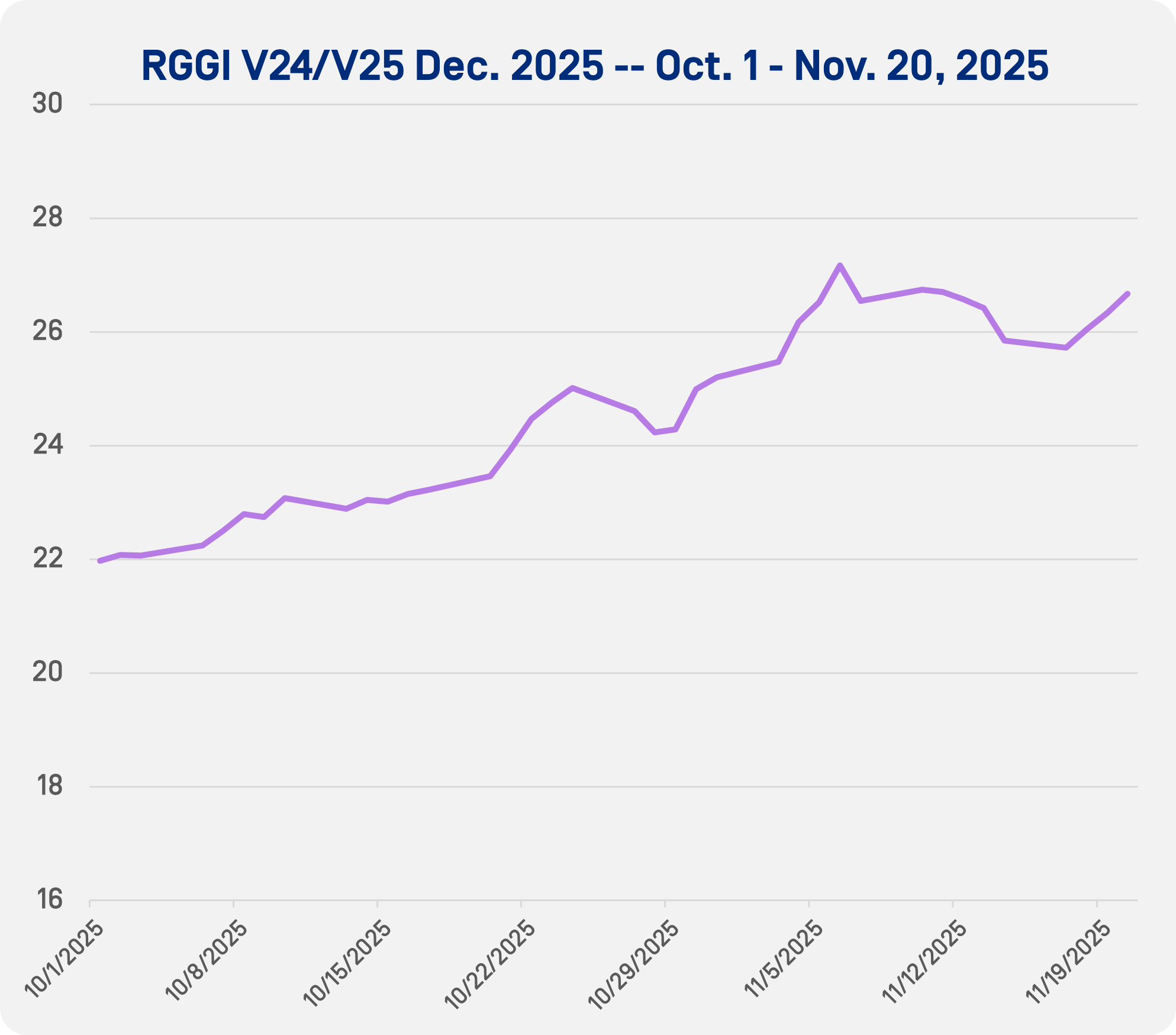 OPIS assessed RGGI prices posted seven straight sessions of gains at the start of November before rallying further to end the month. OPIS assessed the blended RGGI V24/V25 December 2025 price at $27.56/st on Monday, Nov. 24. At the time, this was the strongest assessment for December delivery since all-time high RGGI prices in August 2024.
OPIS RGGI prices strengthened $2.935/st, or 12%, during the seven-session rally beginning Oct. 28. The rally ended with a 63cts/st dip on November 7, and trade prices afterward cooled further to a low of $25.725/mt on Nov. 17. RGGI prices since rose again amid falling temperatures, up $1.835/st for December 2025 delivery through five consecutive sessions as of November 24.
RGGI secondary market prices began to climb in October as the Nov. 4 election day neared for gubernatorial races on the East Coast and regional temperatures began to drop—low temperatures and higher local energy usage often act as a boon to RGGI allowance prices. Between Oct. 16-24, the OPIS blended RGGI V24/V25 December 2025 price strengthened $1.995/st over seven consecutive sessions.
Secondary market RGGI prices have since been volatile as November progressed, amid political developments at the state-level and a slower rate of falling autumnal temperatures.
Democrats Win Gubernatorial Seats in Virginia and New Jersey
RGGI-member states Virginia and New Jersey both elected Democratic governors by significant margins this month.
New Jersey governor-elect Mikie Sherrill defeated a Republican opponent who had pledged to withdraw the state from RGGI if elected.
According to OPIS CAMIRO policy analysis, Sherrill made a campaign promise to declare a state of emergency on her first day in office to “freeze” utility costs and also build clean and affordable energy.
Newly elected Virginia Gov. Abigail Spanberger, a Democrat, will replace Republican Gov. Glenn Youngkin who withdrew the state from RGGI via executive order in 2023. Virginia’s participation in RGGI is currently in limbo, as state courts rejected the governor’s authority to withdraw from RGGI participation.
Bryan noted this week that Spanberger favors renewable deployment along with continued use of natural gas and supports the goal of decarbonizing the state’s electricity sector by 2050.
OPIS RGGI prices reached an initial, early winter 2025 peak on Nov. 6, two days after election day.
In addition, OPIS carbon policy analyst Lee Ann Bryan observed that ahead of the election, polling for East Coast gubernatorial races favored the Democratic candidates, which could have led market participants to expect the votes to lean in favor of the stricter climate policy generally championed by Democratic candidates weeks out from results.
Bryan said market participants could expect a further ramp in RGGI prices as the newly elected East Coast administrations roll out new climate policy and other states update their program rules.
“Energy pricing for residents has been a huge issue for both New Jersey and Virginia. Both new governors want to address that, and have discussed an ‘all of the above’ style approach while still supporting decarbonization goals,” Bryan said. “However, I think that cost issues may continue to take center stage.”
Pennsylvania Budget Bill, Maryland to Adjust Model Rule
Elsewhere in the mid-Atlantic U.S., Pennsylvania Gov. Josh Shapiro signed a budget bill on Nov. 12 that shut the door on partisan debate over RGGI membership. Pennsylvania has never taken part in a RGGI auction due to legal challenges to its participation, though former Gov. Tom Wolf directed the state to join in 2019 with an entry date scheduled for 2022.
According to OPIS carbon policy analysis, the budget bill included a concession from state Democrats to cease pushing for the state to join RGGI.
As part of the state’s budget implementation, legislators repealed provisions “relating to a CO2 budget trading program.”
According to Bryan, budget negotiation talks began to circulate during the week of the election.
Bryan said that though the budget bill closes one route for climate policy in Pennsylvania, “it simply could be a pivot toward a different approach to reduce [greenhouse gas] emissions in the state.” She pointed to Shapiro’s proposed “Lightning Plan” as a potential RGGI stand-in.
“These [Lightning Plan] initiatives build off the Pennsylvania Climate Emissions Reduction Program (PACER), Shapiro’s proposed replacement for RGGI. PACER would establish a cap-and-invest program to set Pennsylvania’s carbon limit and invest in reducing electricity costs,” Bryan said in the OPIS CAMIRO report last week.
Lawmakers in member state Maryland also recently moved to act on directives laid out in the most recent RGGI Model Rule Update.
The Maryland general assembly Joint Committee on Administrative, Executive, and Legislative Review said in a Nov. 7 memo that the state is amending its emissions trading program to incorporate RGGI Model Rule changes.
“Amendments to the regulations will implement the policy changes to the cap and stability mechanisms from the Program Review, remove offsets, eliminate obsolete accounting mechanisms for industrial sources and long-term contracts, and address miscellaneous clerical changes,” according to the memo.
RGGI officials published the new model rule in July 2025, and member states have until 2027 to update their individual programs. According to OPIS policy analysis, Maryland is the first state to adjust its new model rule.
Temperatures Descend in RGGI Member States
According to historical OPIS data, RGGI prices typically rise in the early winter as temperatures cool and heating usage ramps up in participating member states.
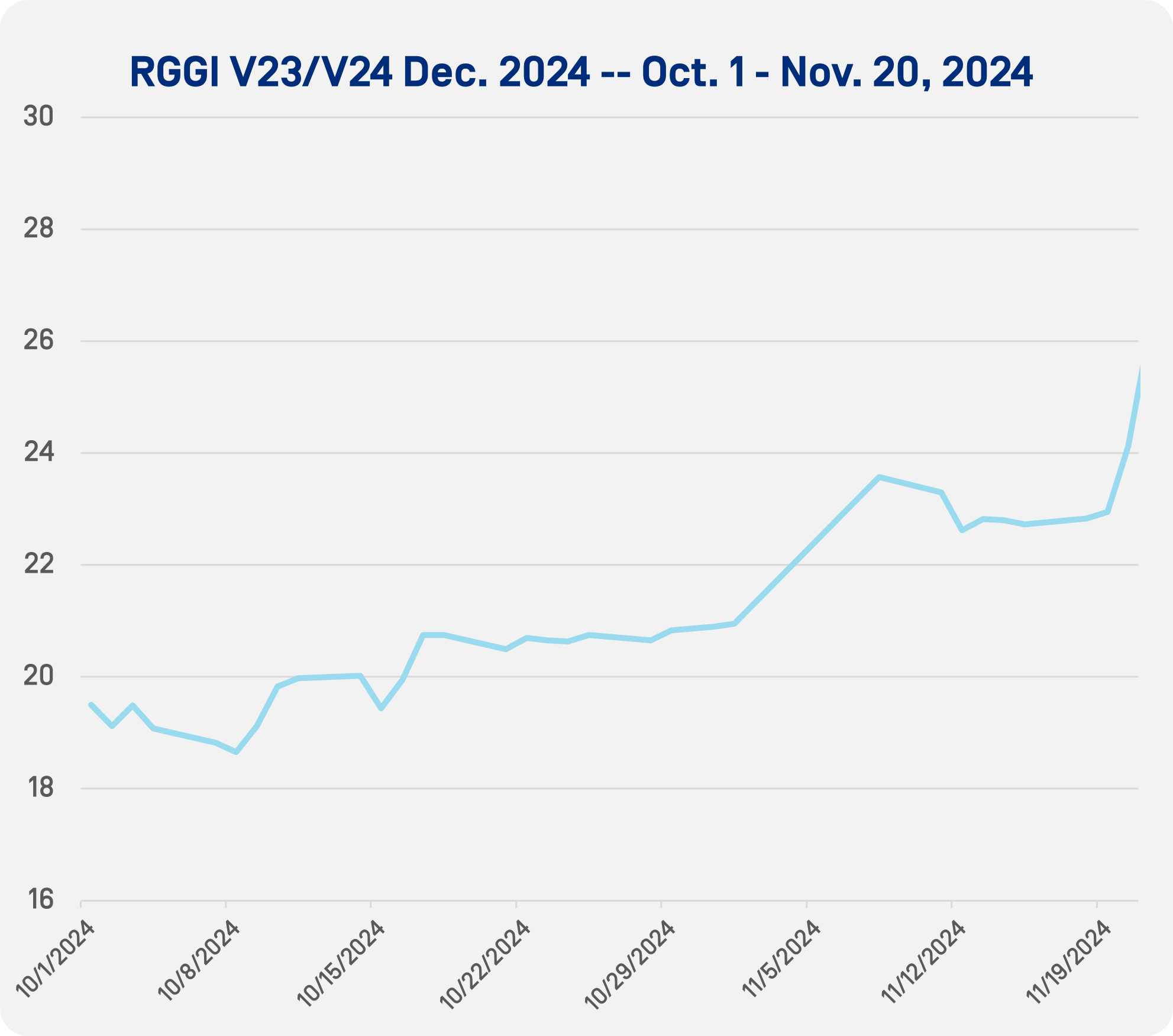 In 2024, OPIS recorded a $3.50/st increase in RGGI prices between Oct. 1-Nov. 27, with a peak at $26.125/st on Nov. 21, 2024. This year prices ramped earlier, peaking at $27.175/st on Nov. 6.
Temperatures in RGGI states this year began to drop precipitously in mid-October, potentially contributing to the growing bullish market sentiment tied to anticipated election outcomes. Temperatures for the Baltimore area this year averaged 64 degrees on Oct. 1-7, according to the National Weather Service. That weekly average chilled to 52 degrees by the last week of the month Oct. 25-31.
In the Boston area, average temperatures fell, from 64.6 degrees Oct. 1-7 to 50.1 degrees Oct. 25-31. In Harrisburg, temperatures fell from an average of 64.7 degrees from Oct. 1-7 to 49.1 degrees during the week of Oct. 25-31.
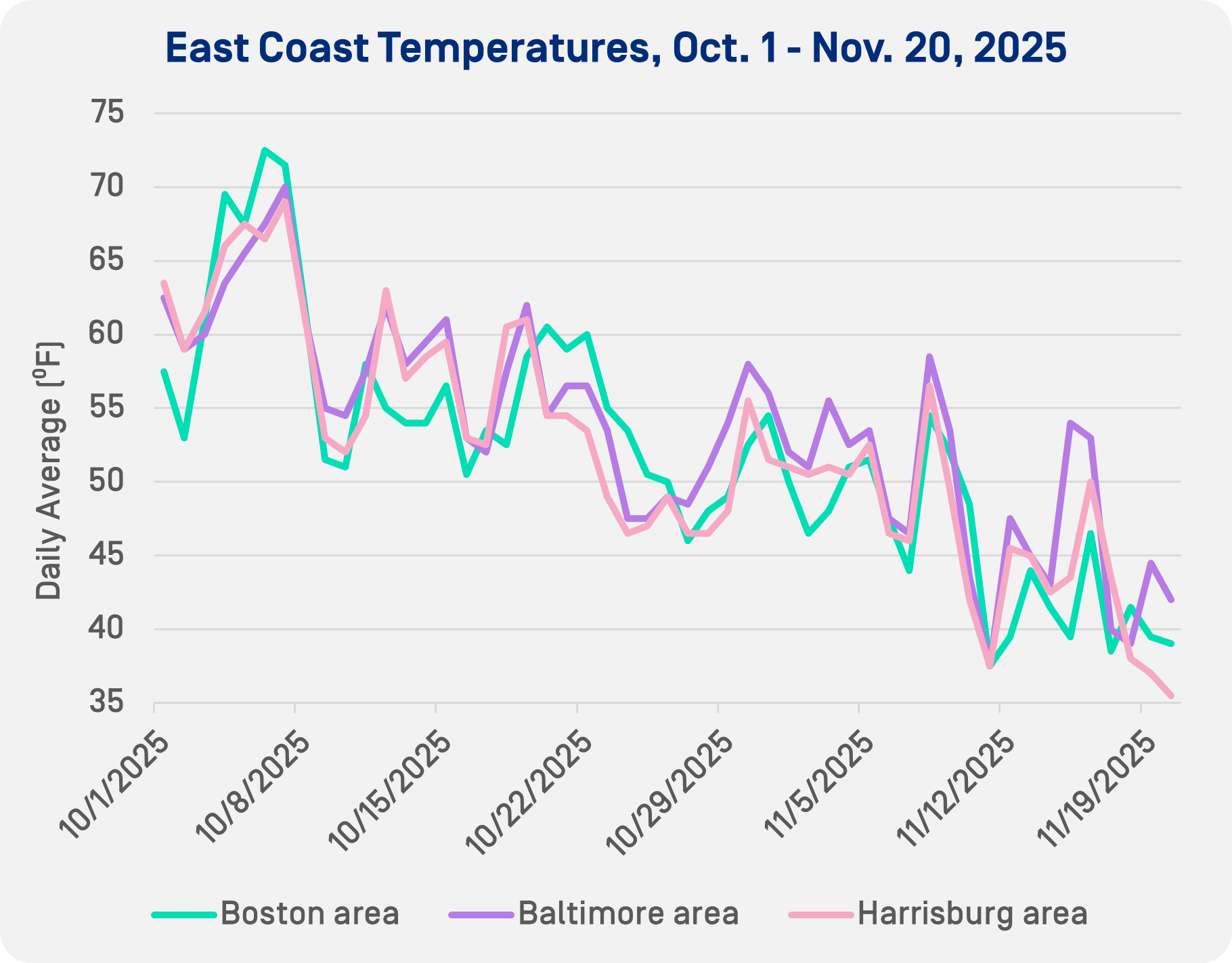 East Coast temperatures fell at a slower rate through the first half of November compared to October, concurrent with a pause in rallying RGGI prices, though averages continued to drop. According to the NWS, the Baltimore area averaged 46.9 degrees Nov. 8-14, while Boston averaged 45.4 degrees and Harrisburg saw an average of 45.5 degrees.
Recently, from Nov. 15-20, the Boston area averaged 40.75 degrees, Baltimore averaged 45.42 degrees and Harrisburg averaged 41.25 degrees.
The fourth quarterly RGGI auction on Dec. 3 offered 15.23 million allowances. The 2025 third quarter auction sold out of 15.17 million allowances and cleared at $22.25/st on Sept. 3.
The RGGI board of directors announced it will hold a public meeting Dec. 15 to approve a 2026 budget, elect executive committee members and to discuss “an update on RGGI, Inc. milestones.”
During more recent trade sessions ahead of the Dec. 3 auction, secondary market RGGI prices rallied further to new all-time highs. OPIS assessed the blended RGGI V24/V25 December 2025 price at $29.135/st on Tuesday, Dec. 2, for a record high assessment.