
West Coast Jet Fuel Stocks Hit Record Highs Amid Weak Demand
West Coast (PADD 5) jet fuel stocks have risen to record highs in 2025 as air travel from the region’s major airports has fallen below pre-pandemic levels.
 Jet fuel holdings across the region averaged 11.13 million bbl over the first half of 2025, up by more than 19% from 2019, according to Energy Information Administration data.
While jet fuel levels have surged, H1 passenger traffic at the region’s three busiest airports—Los Angeles International (LAX), San Francisco International (SFO) and Portland International (PDX) totaled 70.61 million passengers, or about 15% below 2019’s 82.7 million.
“If you look at it right now, we are a bit oversupplied,” one West Coast jet fuel trader said. “With the refinery closure announcements—if one of the remaining ones has an upset, then that position changes, especially if it’s an extended upset.”
LAX and SFO, traditionally the two busiest West Coast airports, reported passenger numbers over the first six months of 2025 were down by about 3.6% and 7.5%, respectively, from the same period of last year.
Portland International, however, has reported its passenger count in the first half of 2025 rose by 7.7% year to year, putting traffic at 90.92% of its 2019 number. Over the same period, LAX said passenger volume was at 78% of the comparable period in 2019, while SFO traffic was at 95% of the 2019 number.
LAX passenger volumes in H1 2025 were off by more than 21% from 2019, while Portland and SFO were down by about 9% and 5%, respectively, helped by steadier domestic travel.
Average refinery utilization in PADD 5 over the first half of the year was at 82%, down from 88.5% over the same period in 2019. The disconnect between inventory levels and utilization, combined with sluggish demand, has pressured prices, OPIS pricing data showed.
LA jet fuel priced at an average 2.08ct discount to NYMEX ULSD futures over the first six months of the year, 3cts weaker than the average 1ct premium posted over the same period of last year. It also was about 6cts below the average 4.69ct premium reported in the first half of 2019, according to OPIS data.
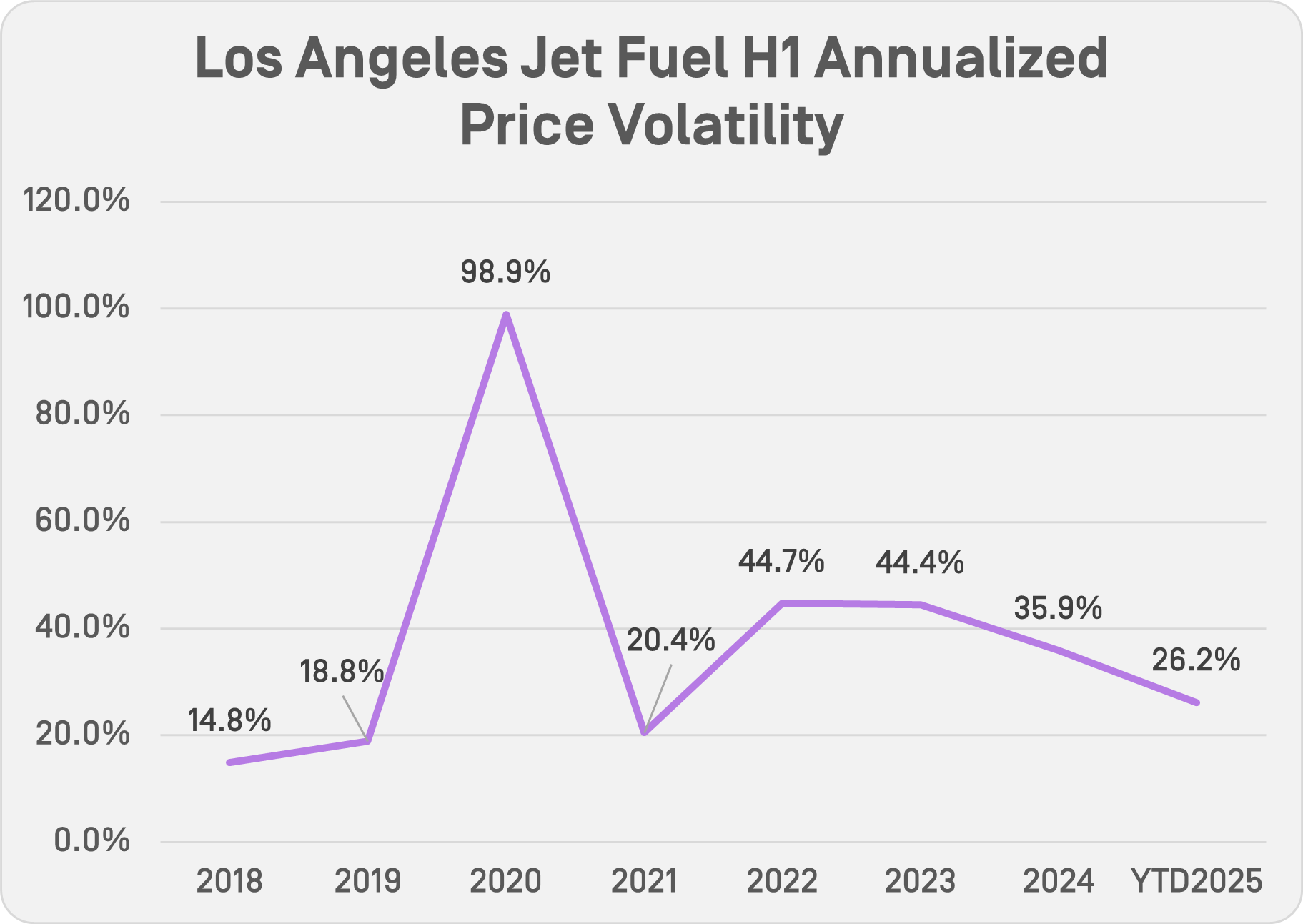
The current stability in the market reflects these dynamics. After a period of extreme price swings during the initial pandemic shock and subsequent turbulent recovery, volatility has consistently fallen.
It dropped to 35.8% in the first half of 2024 and to 26.18% in the first half of this year. This decline, combined with higher inventories and lower demand, suggests a well-supplied and more stable market heading into the second half of the year.
 The long-term outlook, however, has been complicated by the planned closure of two California refineries—Phillips 66’s 147,000 b/d LA facility and Valero Energy’s 149,000 b/d Benicia refinery. During the company’s Q1 2025 earnings call, Valero CEO Lane Riggs explained that the decision to close the Benicia refinery was a direct result of the state’s policies. He stated, “California has been pursuing policies to move away from fossil fuels for really for the past 20 years. And the consequence of that is the regulatory and enforcement environment is the most stringent and difficult of anywhere else in North America.”
EIA supports this view, saying in a July report that the closures are “likely to contribute to increases in fuel price volatility on the West Coast.”
The West Coast operates as a largely isolated fuel market due to the lack of pipeline connections to major U.S. refining hubs like the Gulf Coast. This isolation means that disruptions to regional supply can have significant impacts.
Phillips 66 has announced plans to cease operations at its Los Angeles-area refinery by the end of 2025 and Valero said it intends to shut Benicia by the end of next April.
The loss of the two plants, which account for 17% of the state’s total refining capacity and about 11% of PADD 5 total refining capacity, will likely lead the region to increase its reliance on imports from Asia, increasing the risk of price and supply disruptions, a West Coast market source said.
“We have been preparing for this over the last five years. I would say I’m certainly more on edge than I would have been in the last year,” the jet fuel trader said. “Over the long run, with the refineries that are closing, that market is going to have to be balanced by imports from Asia and we want to make sure that we are tending to those relationships now, as opposed to when everyone else is trying to fight for the same barrels.”