Chemical Feedstocks: Post-Hormuz Crisis, Oil Remains King
The signing of a Memorandum of Understanding (MOU) between the U.S. and Iran on June 17 has had a dramatic impact on energy markets as sentiment shifted from a state of perpetual panic to one of hope and an expectation of a return to normal. The MOU included provisions for the reopening of the Strait of Hormuz and the lifting of the blockade on Iranian ports, triggering a notable and dramatic uplift in vessels traversing the waterway. This ramp-up in supply, together with the assumed continued heavy drawdown on global strategic reserves, has pushed oil prices down to levels not seen since before the crisis began. However, there remains a clear disconnect between crude oil markets and refined products, which continue to trade at a dramatic premium to crude oil due to concerns over availability.
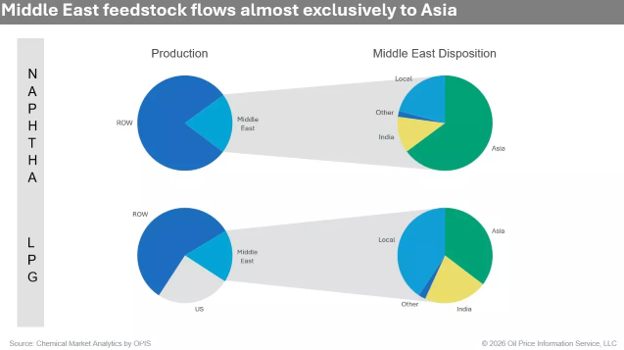
Despite the initial euphoria following the MOU, for crude oil and refined products, the distance to markets means that the supply chain will require several weeks to return to normalcy. Attention will then shift to rebuilding depleted strategic reserves. If the MOU holds and evolves into a peace deal, it is likely that reserve rebuilds will require years of elevated oil demand. Furthermore, the notable loss of refining capacity in the Middle East coupled with damage to liquefied natural gas (LNG) and gas processing facilities, will likely create significant challenges in restoring feedstock flows to normal levels across the region and limit export availability of liquefied petroleum gas (LPG) and condensates. Middle Eastern operators will have to choose between prioritizing exports or domestic consumption, thereby limiting supply to petrochemical operations.
The availability of ethane, the primary feedstock for regional ethylene production, has been affected by the military strikes on gas processing facilities. Before the crisis, some countries in the region had an excess of ethane in their systems which will help ensure that the feedstock availability may well meet demand requirements ahead of a full return to oil and refined product production. Therefore, the question for petrochemical operators hinges entirely on mechanical asset integrity and startup speed.
The military strikes on assets in the region have been notable, though the full extent of the damage remains unclear. While some plants have resumed operations, there has been some impact from falling debris on plants in these countries, and several assets are expected to take some time to restart. Nearly all the assets in the region were brought offline in an unplanned manner, and the risk of damage to furnaces and gas-separation systems at steam crackers is reasonably high. It may take longer than usual for some of these assets to be restored to operation. Globally, the reopening of the Strait of Hormuz will have the reverse impact that its closure saw. A return to lower oil prices has already narrowed the cost advantage U.S. ethane crackers have over other regions whilst Asian markets will gradually see the restoration of feedstock and polymer supply. For Europe, the impact is expected to be limited. Beyond the short-term impact of the reopening of the Strait, the underlying market balance will once again become the focus for the industry.
It is not clear whether the supply chain will move to restock so quickly, but any indication of a potential market shift is likely to make buyers uncomfortable with such low inventory levels. The crisis may have an unexpected consequence in changing the market dynamics for 2027, even if it has done little to bring the industry any support in the first half of 2026.
-Matthew Thoelke, Vice President, Olefins EMEA (matthew.thoelke@chemicalmarketanalytics.com)