
As Trump Drains US Oil Stockpiles, Wright Asks Why Europe and UK Don’t
U.S. President Donald Trump’s top oil official Chris Wright has accused many members of the International Energy Agency of using “funny math” when it comes to calculating the amount of crude and fuel they store in strategic reserves. He may have a point.
In an interview last week with Dow Jones Energy News at Journal House in New York, Wright, a former fracking company CEO now serving as Trump’s secretary of energy, was forthright in his criticism of European countries and the UK for bending the rules on the amount of oil they should be stashing away for a rainy day.
“Why do so many countries in Europe have essentially no strategic oil stores? That’s crazy,” said Wright. “Some countries hold zero strategic crude stocks, and then they just count commercial gasoline and diesel stocks.”
The IEA requires net importers of oil — including the UK — to hold at least 90 days of imports to cover supply disruptions. But the rules are vague and open to interpretation. The IEA gives members “substantial flexibility” for how their commitments are met. The UK asks private suppliers to hold its reserves through a so-called “Compulsory Stocking Obligation” instead of a government-owned stockpile. Wright thinks that is a risk.
“I don’t want to kick the UK out of the IEA, but they should realize, you know, stuff is going to happen. You want to have energy stores in your country. It’s good for your population if we all do it. The United States has very large strategic oil stores. I think everyone now realizes we should have those too.”
In response to Wright’s criticism, a UK government spokesperson said the country was “fully in line with IEA obligations,” adding that stockpiles were “slightly below” the 90-day level required by the energy watchdog following an earlier coordinated release of oil in response to the Middle East crisis.
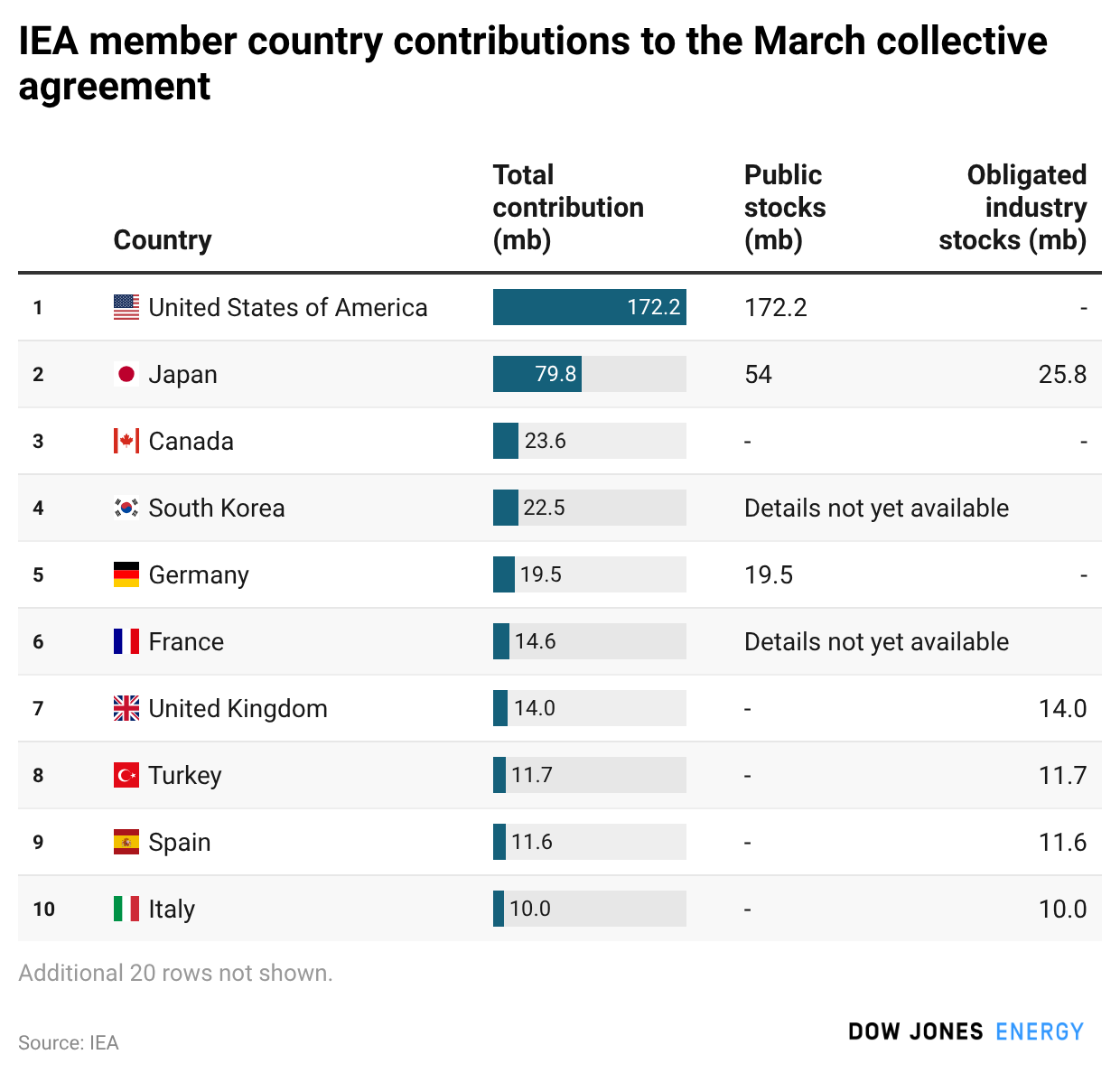
In March, the UK government contributed 13.5 million barrels from its stocks to a coordinated 400-million-barrel emergency release of oil ordered by the Paris-based IEA. At the time, the UK said it held 76.6 million barrels of oil stocks in total.
The UK government spokesperson declined to provide an update on levels or specifics on the ratio of oil stored in mainland UK versus offshore by third parties, including oil traders. The IEA also declined to comment on Wright’s remarks on emergency stocks.
IEA Executive Director Fatih Birol said Tuesday, following a meeting of European energy ministers in Dublin, that two-thirds of the release announced in March had been distributed to the market. “Countries have made a major effort in Europe,” Birol said. “A big chunk of stocks have been released.”
Birol added that only 20% of total stocks held by IEA countries had been made available. The U.S. has been shouldering the biggest share of the burden in terms of using its stocks to try and cool markets.
The U.S. entered the Middle East crisis with about 413.5 million barrels of crude stored deep inside its own salt caverns at the end of 2025. The stockpile had fallen to 283.3 million barrels this month, according to the latest Department of Energy data. Meanwhile, U.S. crude production has risen to record levels, averaging 13.9 million b/d this month.
Proportionally, the U.S. has sacrificed more of its strategic stocks than other IEA members.
“Bad things happen, interruptions happen in the world. You need to be prepared for them. It [the IEA] needs to be maniacally focused on what it was founded for, which is energy security,” said Wright, adding that the U.S. would leave the IEA if it failed to reform.
Despite stock releases, fuel prices have continued to rise everywhere. CIF diesel cargoes in Northwest Europe assessed by OPIS have averaged $1,237/metric ton since the start of March, compared with $692/mt throughout 2025. Diesel prices in the U.S. have reached new records above $6.50 a gallon in September.
“I anticipate the U.S. will push hard on increasing the IEA mandate [stocks], and I think they are right to do so,” said Neil Atkinson, senior fellow at the National Center for Energy Analytics and former head of the oil division at the IEA.
–By Andrew Critchlow, andrew.critchlow@dowjones.com