
Europe Faces Mounting Gas Supply Risks Ahead of Winter
Middle East Conflict Upends Global LNG Market Dynamics
Since the outbreak of the US-Iran conflict at the end of February, gas prices in both Europe and Asia have risen sharply, pushing forward curves into backwardation. The conflict has effectively closed the Strait of Hormuz, through which approximately 20% of global LNG trade transited prior to the disruption.
As a result, LNG exports from Qatar and the UAE have fallen significantly amid ongoing security concerns. European buyers attempting to refill storage during the traditional summer injection season have therefore found themselves in direct competition with Asian utilities seeking replacement spot cargoes for disrupted Middle East LNG supplies.
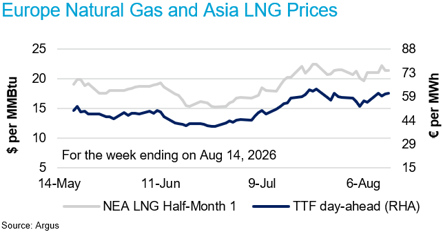
Asian spot LNG prices continue to hold a premium over European benchmark prices, limiting Europe’s ability to attract incremental spot cargoes. At the same time, uncertainty regarding the re-opening of the Strait of Hormuz has put upward pressure on global LNG trade flows and reinforced market risk premiums.
Additionally, around 13 Mtpa, or 17% of Qatar’s operational LNG production capacity is expected to remain offline for 3 to 5 years while its war-damaged facilities undergo repairs. This has materially tightened the medium-term LNG supply outlook. Furthermore, the phased start-up of Qatar’s giant 32 Mtpa North Field East LNG expansion project is expected to be delayed from the end of 2026 until at least mid-2027, postponing a major source of new global LNG supply.
The European Union’s 90% Storage Target Looks Increasingly Difficult to Achieve
Aggregate European gas storage inventories exited winter 2025-26 about 28% full or around 29 bcm, representing the lowest end-of-winter level since the 2022 energy crisis. Current storage levels stand at roughly 60%, or around 64 bcm.
This leaves a gap of approximately 30-34 bcm if the European Union’s 90% storage target before the start of winter is to be achieved. However, current market conditions do not support rapid storage injections. Backwardated forward curves have reduced the economic incentive to store gas, while higher LNG prices make replenishment increasingly costly.
Considering this market reality, flexibility clauses restorage targets introduce by the EU in 2025 are likely to be implemented. This includes greater flexibility around storage obligations, including permitting member states to meet the 90% target between 1 October and 1 December rather than by a fixed 1 November deadline. Additionally, a 10% lower filling target to 80% has become a more realistic base-case scenario.
Russian Gas Imports Could Remain Influential in the Near-Term
Since the energy crisis in 2022, Russia’s share of European gas imports has fallen from more than 40% to approximately 13%. The EU remains committed to eliminating Russian gas imports by 2027 and has introduced a phased series of measures aimed at gradually eradicating dependency.
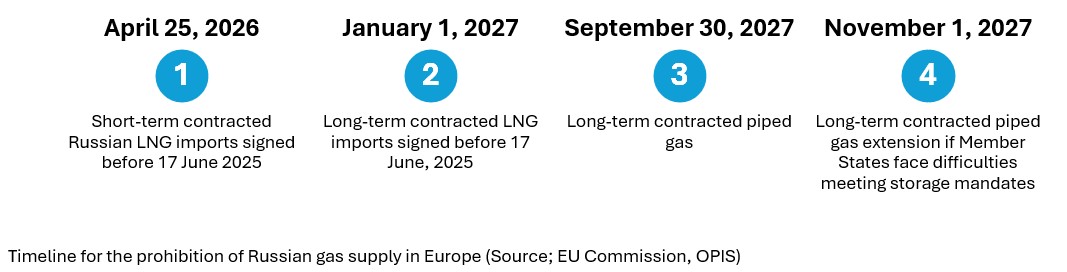
Nevertheless, Russian gas continues to provide an important source of supply flexibility. Imports from Russia’s Yamal LNG reached a record high of 13 bcm in 1H 2026. European offtakers likely sought to secure volumes ahead of restrictions on long-term contracted supplies and dampen the impact of the Middle East supply crunch. It’s possible that Russia continues to play a stabilising role in European supply balances over the coming months, even as EU policymakers work toward its phase-out.
Norwegian Gas Exports Reduced Through Much of the Upcoming Winter
The near-term supply outlook has been further tightened by disruptions to Norwegian gas production. On 10 August, TTF prices surged by more than 10% to around $20.60/MMBtu on the news that production curtailments at the Ormen Lange gas field will be extended until 1 February, 2027. The extended outage will remove around 1 bcm of piped gas supply from the market during the winter heating season, further increasing Europe’s reliance on LNG imports.
Conclusion
Europe is entering winter 2026-27 facing one of its most challenging gas supply environments since the energy crisis of 2022. LNG supply disruption in the Middle East, constrained storage replenishment, declining Russian imports, and reduced Norwegian supply have collectively tightened the market at a time when inventories remain below historical norms.
While policy flexibility may allow EU member states to avoid missing storage obligations, lower inventory levels would leave the region more exposed to cold weather, supply outages, and price volatility. European gas markets are likely to remain tight, highly competitive, and vulnerable to further supply shocks.
By Lynn Morris