
Record Crack Spreads Highlight Global Supply Tightness
The initial stages of the U.S.-Iran conflict were focused on crude oil and the impact of the Strait of Hormuz closure would have on crude oil availability, but that focus has shifted from crude availability to product availability over the last couple of months.
Challenges remain in moving crude oil as the traffic through Strait of Hormuz is nowhere near pre-war levels, but the degree of difficulty has been raised by the Houthis announcing an embargo on Saudi Arabian exports via the Bab el-Mandeb strait and the Russia-Ukraine war has caused a pause of loadings at the Caspian Pipeline Consortium in the Black Sea.
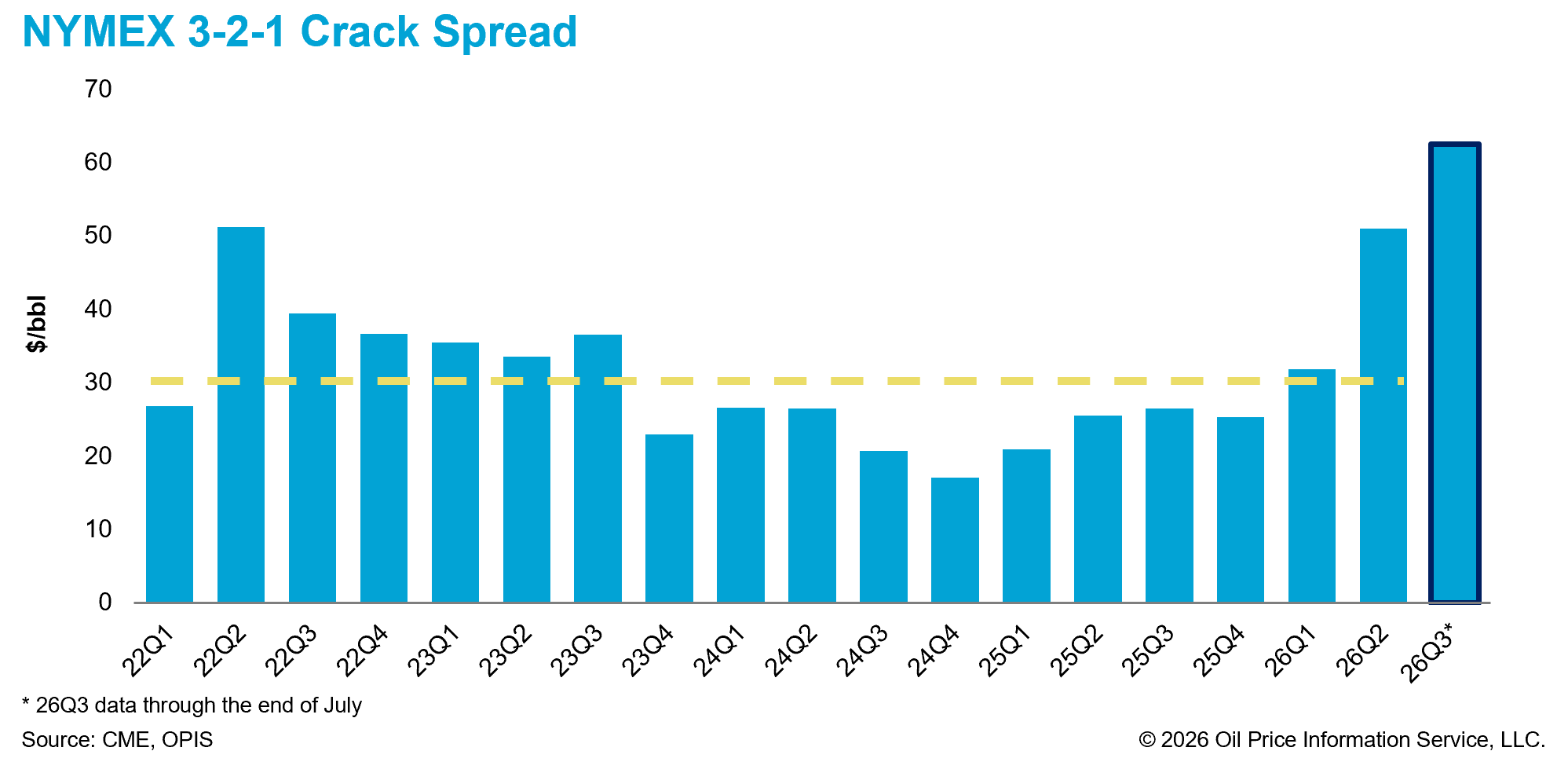
Tighter product markets have been captured in the NYMEX 3-2-1 crack spread. The 3-2-1 crack spread is an estimate of refining margins whereas three barrels of crude oil will yield two barrels of gasoline and one of diesel.
Recently, the NYMEX 3-2-1 crack spread reached an all-time high of $72/bbl as refineries continue to run at high rates, yet inventories are not necessarily recovering. Constant attacks by Ukraine on Russian refineries have also forced Russia into the suspension of exports of gasoline and diesel. Russia is a significant exporter of diesel, with estimates of 0.8-1.0 million b/d.
The announcement of the ban on Russian exports was a key driver of the July refined products rally. Tight U.S. inventories as well as strong export rates also provided additional support.
On a quarterly basis the crack spreads are starting to exceed the previous records in 2022 after Russia invaded Ukraine. The difference between the crack spread rally in 2022 and 2026 was gasoline is a more willing participant this time around. Four years ago, strength in the crack spread was driven almost exclusively by ULSD as the diesel crack spread versus West Texas Intermediate eclipsed $100 a few times in 2022. The diesel crack has not yet achieved those lofty levels, but in late July reached the high $90s.
The second quarter of 2026 3-2-1 crack spread averaged over $51/bbl, just 20cts shy of the same quarter four years ago. July has just ended, but one month into the third quarter shows the potential for those records to be shattered.
Inventories of the marquis U.S. products, gasoline and diesel continue to point to the “just in time” nature of petroleum product deliveries. While inventories are tight, the distribution of products has not been affected with few reports of station run outs this summer.
Gasoline gets the most attention as retail prices got as high as $4.55/gal, according to AAA, this spring. Prices spent the last week of July in and around $4.10/gal area. The initial rally in retail gasoline prices was largely driven by crude oil increasing to triple digits, but this last push in prices has been more a function of tightening supply.
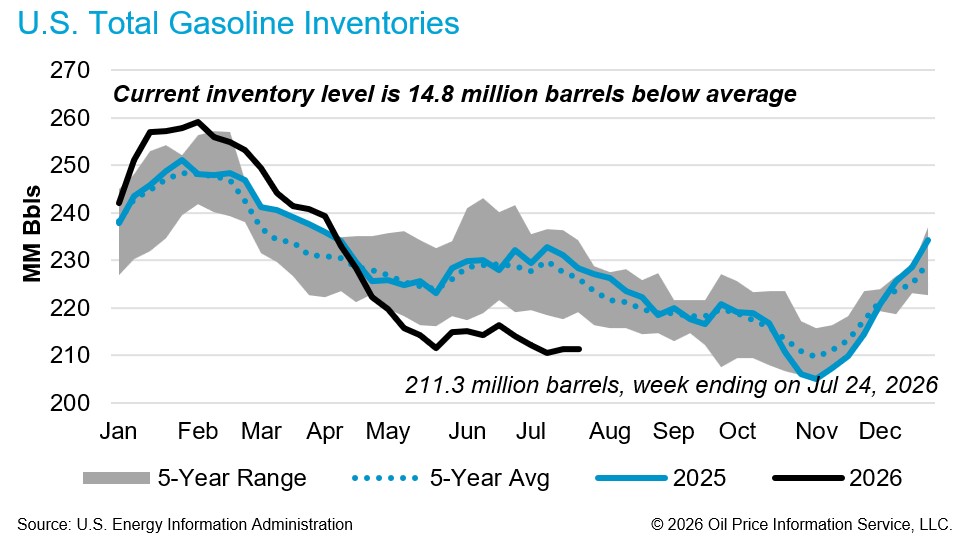
Before the war began in late February gasoline inventories in the U.S. were quite comfortable running well above seasonal norms. A combination of the formulation switch from winter grade gasoline to summer grade gasoline, increased exports and seasonal demand all conspired to pull gasoline supplies well below normal.
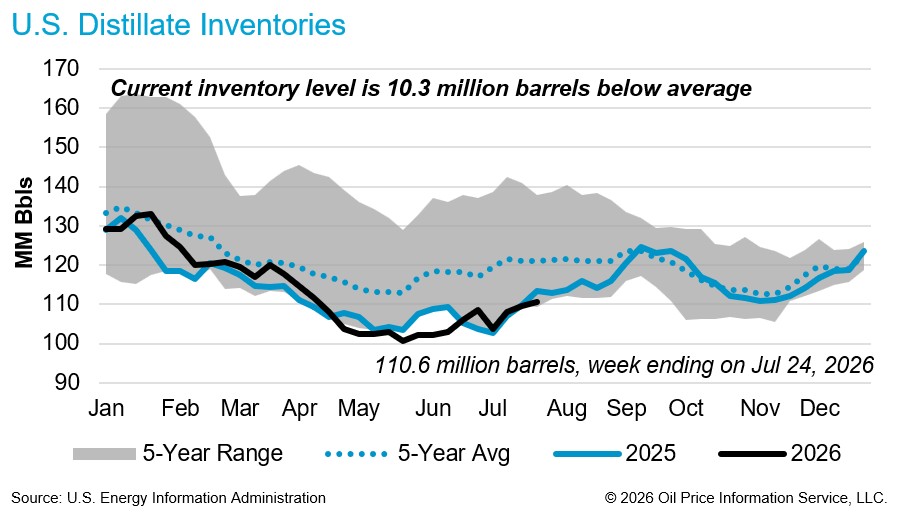
Distillate supplies in the U.S. have been tight for much of the past 18 months running along the lower band of the five-year range.
Refiners have been maximizing the middle of the barrel as EIA data shows production above 5 million b/d for much of the last three months. This has kept the U.S. downstream system supplied, but also has allowed for strong export rates as May data for distillate exports came in at 1.655 million b/d the second highest on record.
The crack spreads have taken a small step back since reaching record levels, however with refinery operations just about maxed out and global supplies still tight, there is no reason to believe refining margins are going to slide anytime soon.
–Denton Cinquegrana