
The US Treasury’s Bond Market Intervention and What it Means for Commodities
“Bond traders can stop panicking when the Fed starts to panic.”
– Old Wall Street adage
On Wednesday, August 19 for the first time under Secretary Scott Bessent the US Treasury Department announced direct interventions into the US bond market. Specifically, Treasury announced that it was at least doubling the size of buybacks of longer dated debt (10- to 30-year debt) from $2b to “at least” $4b for “liquidity support.” Today we examine this announcement, what it means (and perhaps more importantly what it doesn’t mean), and what this means to our clients.
Why Intervene Now?
It’s no secret that when assessing the fiscal situation and outlook of the world’s largest economy we heavily favor focusing on the bond market instead of the stock market. See Tariff Talk: The ride of the Bond Vigilantes (subscription required). It has been one of our core macroeconomic themes for the last few years and is our focus today.
But why has the Treasury intervened now? Back in our inaugural Tariff Talk we chose to focus on bond yields as the reason that Trump called off many of his tariffs. See Tariff Talk: Why is this trade war happening? A big part of it is Treasuries and debt (subscription required). At the time we quoted the President saying that he reversed course because people in the bond market were getting “a little queasy.”
After a bit of volatility, aided by the Federal Reserve cutting rates 125bps along the way, longer-dated treasury yields slowly started declining after Liberation Day. Markets shrugged off persistent high inflation along the way and by earlier this year the 10-Year had fallen back under 4%. Until Iran. Once the US and Israel bombed Iran in late February and what was widely seen as only a 3–5-day excursion turned into a war that will reach half a year next week, bond yields reversed and started marching higher.
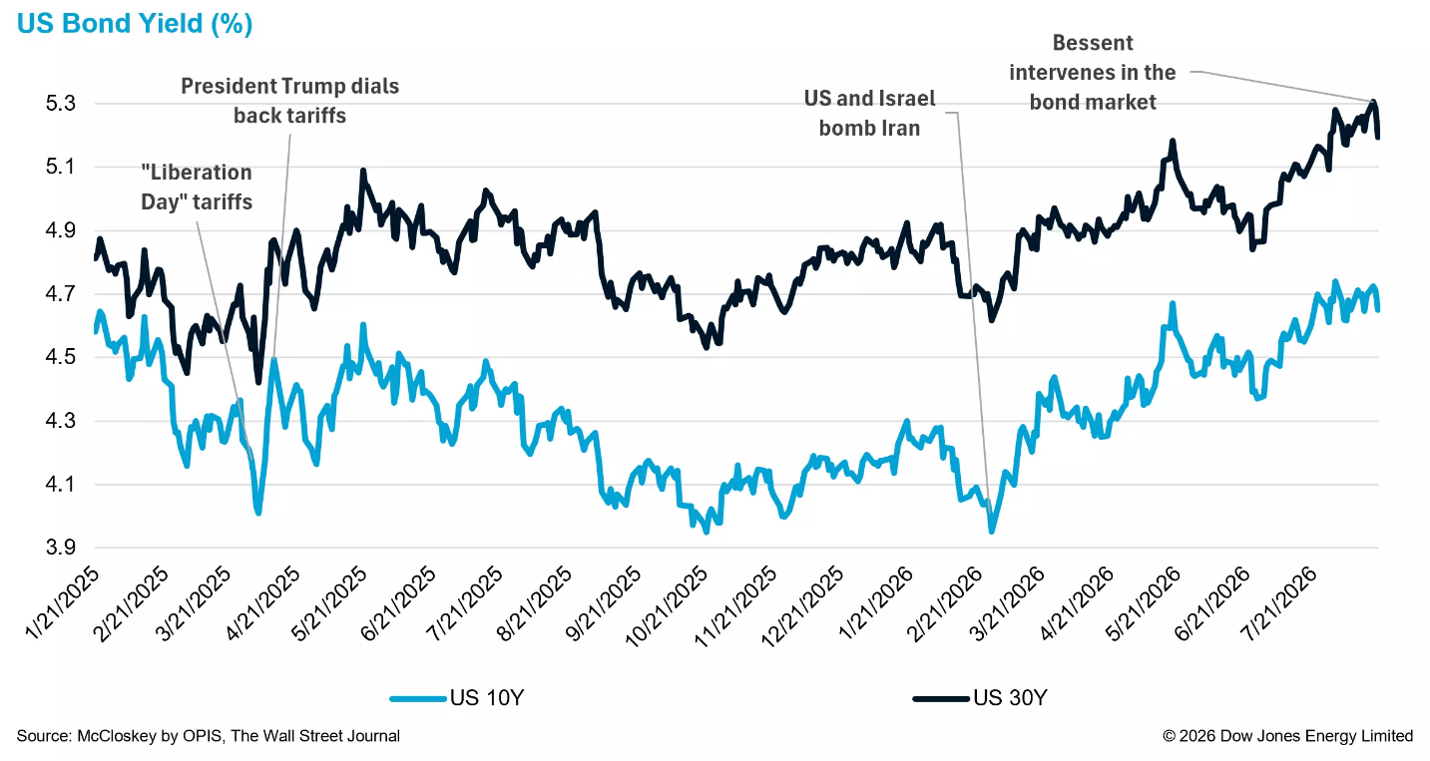
Figure 1.
By the time Scott Bessent intervened earlier this week, the 10Y was threatening to break out decisively above the 4.7% level while a 30-year bond auction cleared at the highest yields since 2001 (for more information on how bond auctions work. See Tariff Talk: Understanding a treasury auction and what it tells us (subscription required).
Interest payments are now the second largest line-item of federal spending and, at 3.3% of GDP, are the highest as a percent of GDP that they have been in at least 80 years. The situation was rapidly deteriorating so it was of little surprise that Bessent intervened. But the question remains: why now?
This is a bit harder to answer than it may seem at first. Generally, the Treasury is a fairly predictable institution, by design: no one wants surprises when dealing with $40T in debt – a mark the US hit earlier this week. As part of its predictable operations, Treasury usually announces changes to debt management policy during their “Quarterly Refundings.” The last of these quarterly events was the first Wednesday of August and the next is the first Wednesday of November. But nothing was announced a few weeks ago on the first Wednesday of August. So, the question stands, why now? For now, we don’t know, but in our view, it implies something was causing urgency.
Is this Quantitative Easing?
Going through a few of the more common questions, let’s look at what this is and what it isn’t. First, no, this is not quantitative easing. Quantitative easing is the creation of money (at the Fed) to buy assets – thus injecting money into the system. Treasury cannot create money. Rather, this is buying longer-dated bonds with the proceeds from selling shorter-dated bonds like T-Bills.
A lot of those bonds were issued when rates were far lower, so they are trading below face value. And Treasury is buying them at market price and retiring bonds at face value. So, while this technically creates a small amount of value, it is not quantitative easing but rather the issuance of short-term debt to buy long-term debt.
Is this Yield Curve Control?
We have written about Yield Curve Control (YCC) when it comes to Japan before. See Tariff Talk: Japan’s stimulus, the carry trade and the global economy (subscription required). YCC is setting explicit caps or targets on different bond terms. Treasury is not doing this explicitly here. This is more “yield curve control adjacent” and not explicitly YCC. This is more along the lines of the “Operation Twist” efforts by the Fed in bygone years that were aimed at suppressing longer-dated yields by doing something similar to the recent Treasury intervention.
Is this “liquidity support” as Treasury claims? Is there even a liquidity issue on longer-dated bonds?
A liquidity problem would show up if the spread between shorter-dated (say 2-Year bonds) was blowing out against longer-dated (like 30-Year bonds). Since 30-Year bonds were first issued in 1977, that spread has averaged about 1.22%. On the day before Bessent announced this Treasury action, that spread was 1.09%. If anything, that spread was slightly lower than it has been historically.
So, in short, no. There is really no liquidity issue on longer dated bonds.
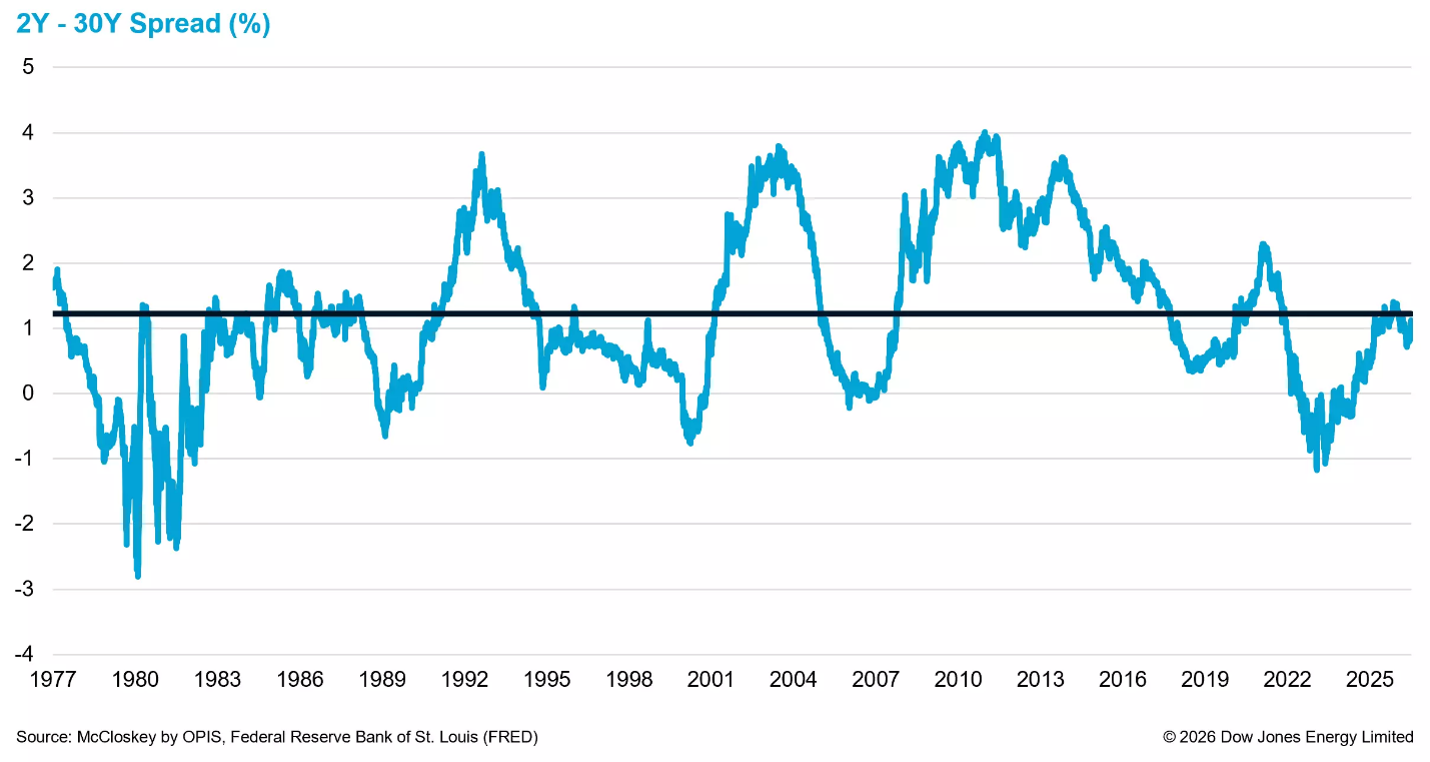
Figure 2.
It’s $4 billion. Why should we care?
This is a fair question. It took from the founding of the country to late 1981 for the national debt to hit $1 trillion. US debt just sprinted from $39T to $40T in 95 days. We are currently adding about $8b to the debt every day in the US. Given that increase why do we care about $4 billion? We care for a few reasons:
First, it’s “optics.” Treasury is signaling to the market it is going to take a much more activist stance and is feeling out a market response.
Second, intervention almost certainly does not stop here. The Treasury statement pointed to the increase starting at $4 billion, not ending there. Furthermore, we think Treasury would need additional help from the Fed and others. We think the market has not caught on to the Fed not participating in this (yet) which we find interesting, and $4b alone is really nothing in the scheme of US debt, but it’s the signaling that matters.
This intervention will continue until the day after US midterms elections on 4 November. Is this politically motivated?
We’ll give Treasury the benefit of the doubt here. In short, no. Remember those Quarterly Refundings we wrote about? The next one is November 4.
Why do I care as a commodity person?
We would argue you people in the global commodity markets should care deeply about this. We have repeatedly pointed to how the Trump Administration wants a weaker dollar. See Tariff Talk: A weaker US dollar? (subscription required). The dollar has remained strong for now mostly due to unprecedented geopolitical unrest but also higher prices of things like oil that transact in dollars (more dollar demand vs no change in dollar supply = higher dollar value). But as we have written before, interventions to artificially suppress bond yields weaken a currency significantly. Just ask Japan. See Tariff Talk: The yen hits a 40-year low – what now? (subscription required).
And not unexpectedly, since the war began the dollar has strengthened. However, that strengthening has recently reversed and reversed fairly sharply with Treasury intervention.
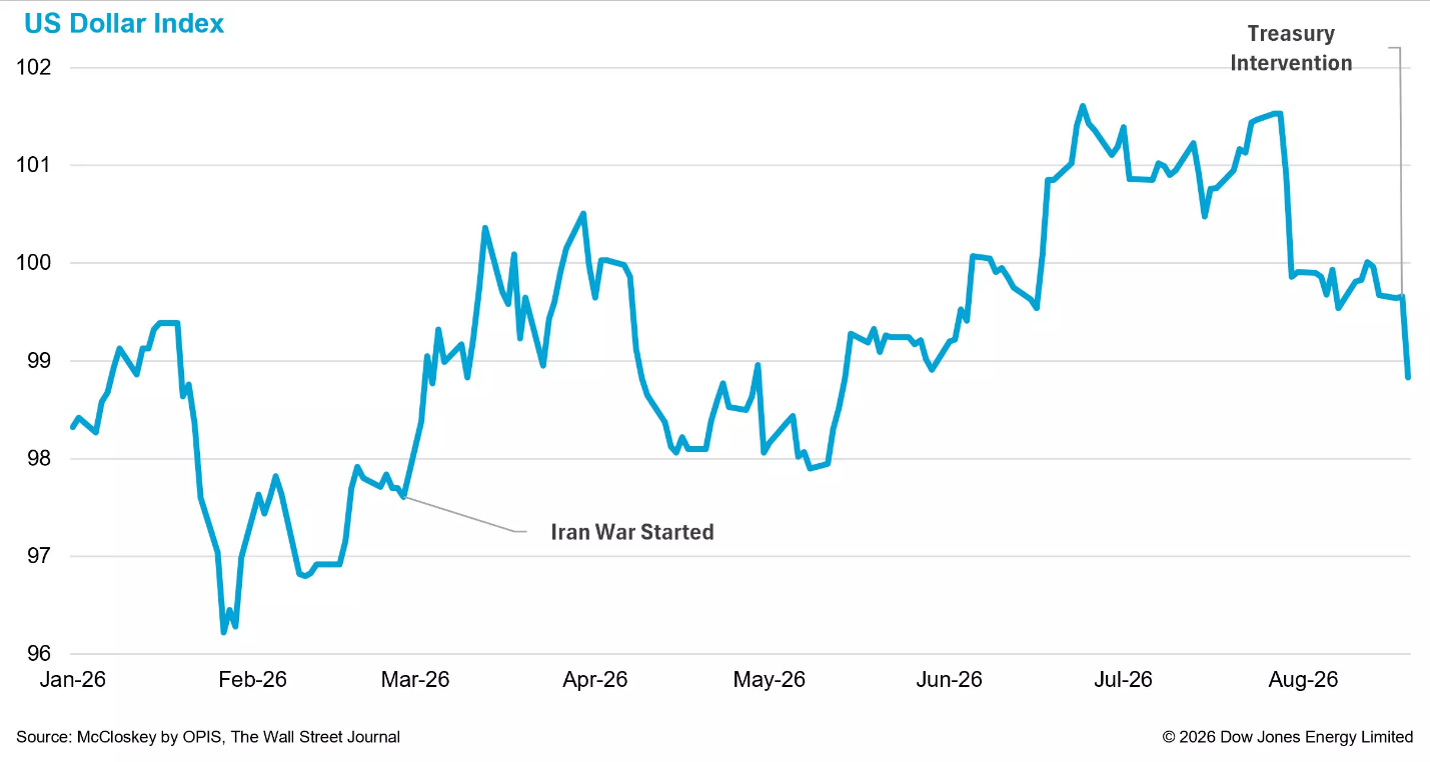
Figure 3.
A weaker dollar means US exports are cheaper – good for US commodity exporters, such as those in the metallurgical coal and ferrous scrap markets – but also means US imports are more expensive. With record trade deficits, a weaker dollar is inflationary for already struggling US consumers. Furthermore, a weaker dollar means that everything priced in dollars (from oil to coal to chemicals) – all else being equal – goes up in price. Good for domestic producers, bad for consumers.
A weaker dollar is, of course, bullish most global commodities since they are mostly demarcated in dollars.
What does this all mean?
Treasury is fighting the bond vigilantes pushing yields higher. They decided to launch this significant salvo in between Quarterly Refundings, meaning there was some compelling reason to do.
We think this backfires. The market will smell blood in the water, assume the worst, and respond accordingly – and in the last few days we have seen this. We don’t think this Treasury move is enough to arrest a continuing weakening of US bonds / increasing of bond yields. If anything it adds more questions. Until the Fed starts to take inflation that is now above target for 65 months seriously, we expect yields to continue to rise.
But this is certainly a change in messaging from Treasury. If indeed Treasury plans to get much more active in the bond market – and much more importantly brings the Fed along in a significant way in the future – while it might suppress bond yields it also will weaken the dollar. As noted, a weaker dollar is bullish for most of our commodity-focused clients, but we remind our clients that a weaker dollar is also inflationary.
We see no easy way out of this mess in our view except a reduction in deficit spending – and we don’t see that happening anytime soon and even then, that reduces GDP and GDP growth. But we do note this isn’t entirely a US phenomenon. Debt yields are rising (nearly) globally at an alarming rate. Next week, we pull back and look at the global debt situation as well.
–Charles Dayton, Director, Research & Analysis
–James Stevenson, Vice President and Research Lead