
New Mexico’s First CTFP Forecast Points to Credit Surplus Through 2027
New Mexico’s Clean Transportation Fuel Program (CTFP) is projected to end its first compliance period with a surplus of 429,797 credits, according to the state’s first annual Transportation Fuel Supply Forecast. Published by the New Mexico Environment Department (NMED) on Oct. 29, the forecast projects about 1.35 million credits and 918,000 deficits from the program’s April 1 launch through the end of 2027.
Because of this surplus, NMED will not need to issue a “forecast deferral,” which would let it temporarily relax program parameters if credits were to run short. Instead, the program would enter 2028 with a credit bank equal to about two-thirds of 2027 deficits, which participants could draw on as carbon intensity (CI) targets tighten.
Table 1: Forecast CTFP Credits, Deficits and Bank Balance

Source: NMED 2027 Transportation Fuel Supply Forecast, Tables 8 and 9
Drop-In Biofuels Dominate Credit Supply
Drop-in biofuels, led by renewable diesel, account for most of the CTFP credits projected through 2027. Using an adoption curve that mirrors the first seven quarters of Washington’s Clean Fuel Standard, the forecast projects New Mexico’s renewable diesel blend rate will rise from 5.5% (29.2 million gal) this year to 14.9% (110.9 million gal) in 2027. At that volume, renewable diesel alone would generate enough credits to cover all 2027 deficits from clear gasoline, the program’s largest deficit source.
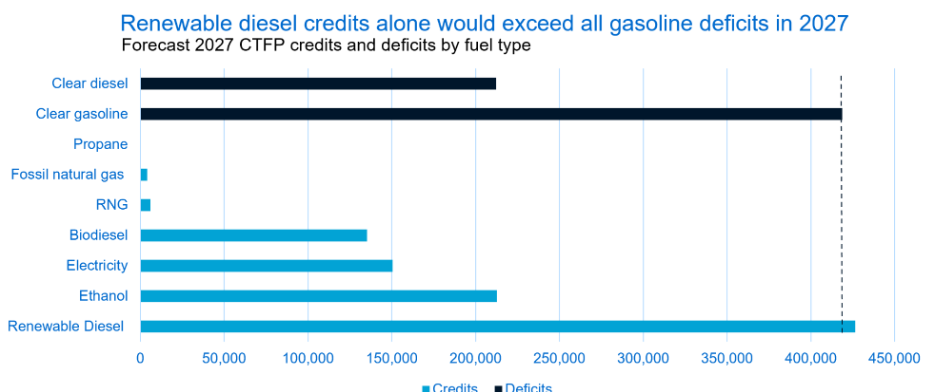
Source: NMED 2027 Transportation Fuel Supply Forecast, Table 10
Ethanol is the second-largest CTFP credit source. The forecast expects New Mexico’s ethanol blend rate to reach 11.4% in 2027, above historical levels. That equals 104 million gal and mirrors the growth Washington saw after launching its program.
Biodiesel and renewable natural gas (RNG) play smaller roles, with biodiesel modeled at a 3.8% blend rate and RNG barely registering because New Mexico has few natural gas vehicles to use it.
However, the NMED report itself gives conflicting figures for both fuels, which appear to be clerical errors. It puts 2027 biodiesel use at both 28 million gal and 28.5 million gal, and the 2026 RNG blend rate at both 45.8% and 45.4%. It also makes the RNG available to New Mexico through book-and-claim accounting as both 503.3 million and 492 million gasoline gallon equivalents, either way far above forecast demand.
Electricity is the fastest-growing source outside biofuels, with credits from charging EVs climbing 56% as the state’s EV fleet grows to about 32,000 vehicles. The forecast does not count any credits for building EV chargers. That is not because it expects no new charging projects, but because Washington took seven quarters to award its first infrastructure credits, and the report expects similar administrative delays in New Mexico.
State and Federal Policies Shape New Mexico Biofuel Supply
The forecast leaves out a state law that could lift biodiesel well above its 3.8% assumption: New Mexico’s 5% biodiesel blending mandate under the Petroleum Products Standards Act (Section 57-19-29 NMSA 1978), which requires every gallon of diesel sold in the state to contain 5% biodiesel. Renewable diesel does not count toward the requirement, so any added biodiesel would come on top of the forecast’s renewable diesel growth. As Dow Jones Energy (DJE) reported, the New Mexico Department of Agriculture (NMDA) suspended the mandate from Oct. 17, 2026, through April 16, 2027, with enforcement set to resume April 17.
If the mandate is enforced on schedule, the state’s biodiesel blend rate would be at least 5% for most of 2027. That would add about 6 million gal of biodiesel and roughly 30,000 credits, according to DJE calculations that assume a 5% blend from April 17 at the forecast’s biodiesel CI. This would raise the net 2027 credit generation by about 10%. However, the mandate has been waived or suspended repeatedly since it was enacted in 2007, and NMDA said enforcement will begin “unless data indicates otherwise.”
Federal policy is shaping which biofuels reach New Mexico. Rising U.S. Renewable Fuel Standard volume requirements and the 45Z clean fuel production credit favor domestic soybean and canola oil over imported used cooking oil, which has a lower CI. As a result, the forecast assumes biodiesel and renewable diesel supplied to New Mexico will be made from soybean and canola oil, with CIs of 54.78 gCO2e/MJ and 62.71 gCO2e/MJ, respectively. Higher CIs mean each gallon earns fewer credits, and the forecast’s credit totals already reflect that.
California’s 20% cap on Low Carbon Fuel Standard (LCFS) credits from virgin crop oil feedstocks takes effect Jan. 1, 2028. The report does not expect the cap to affect New Mexico during the current compliance period, but said producers may begin repositioning supply chains ahead of it, making New Mexico an alternative market for crop-based fuels that previously served California. Together with federal policy, this points to more crop-based biofuel available to New Mexico, but at CIs that earn fewer credits per gallon than lower-CI feedstocks would.
Competition for low-CI feedstocks from West Coast programs and changes to the RFS or 45Z could further alter fuel supply or market participant behavior. The report also flagged federal challenges to state zero-emission vehicle standards as a risk to EV adoption and the credits it generates. Democrats’ Nov. 3 midterm wins in both chambers of Congress may limit additional federal action against those standards. However, the 2025 resolutions revoking California’s vehicle waivers, which New Mexico’s standards rely on, are likely to stand under a Republican president.
Outlook
OPIS-assessed New Mexico CTFP average credits at USD 120/metric ton on Oct. 14 and again on Nov. 3, after the forecast’s release. With a bank approaching 430,000 credits and no supply shortfall in sight, the forecast points to manageable compliance costs and limited near-term compliance pressure for obligated parties through 2027.
The projected surplus rests on assumptions that carry significant uncertainty. The forecast was prepared before CTFP reporting data for the first activity quarter (April-June 2026) were released and draws largely on data from other states. Much of the projected surplus also depends on the renewable diesel blend rate nearly tripling in a single year.
Not every uncertainty points toward a smaller surplus, however. RNG is one area where the forecast may understate credit potential. Because New Mexico allows book-and-claim accounting, RNG could cover all on-road natural gas demand rather than the roughly half the forecast assumes, though that alone would add only a few thousand credits, according to DJE calculations. The forecast also assumes all RNG is landfill gas with a CI of 63.63 gCO2e/MJ, but dairy and other lower-CI RNG would earn far more credits per unit. RNG’s contribution could therefore grow without any more natural gas vehicles on the road.
The 2028 forecast, due by Nov. 1, 2027, will be the first to test these assumptions against actual New Mexico program data.